


The main methodologies for calculating a carbon footprint, including the GHG Protocol, categorise greenhouse gas emissions into 3 boundaries: these are scopes 1, 2 and 3.
Scope 1 covers a company's direct emissions (for example, fuel used for company vehicles), Scope 2 covers indirect emissions linked to energy (for example, emissions linked to electricity consumption), and Scope 3 covers all other indirect emissions.
In this Scope 3, you will find, for example, the purchase of raw materials, the purchase of services, or even home-to-work travel. This scope generally represents the vast majority of a company's emissions, sometimes up to 95% of total emissions.
This is why accounting for Scope 3 is essential when calculating a company's total carbon footprint, and decarbonising this scope is a major challenge in companies' low-carbon transition.
But it's also the most complex. Scope 1 and 2 emissions data are often "simple" to track. This isn't the case for Scope 3, which requires sourcing data across the company's entire value chain, covering activities well upstream or downstream of production - including precise data from the company's suppliers.
How do you obtain all the data needed to calculate Scope 3? What do we mean by specific, semi-specific and generic approaches? Which approach should you choose depending on the data available? What are the sector-specific considerations?
1. Specific, semi-specific, or generic approach?
Before diving into the topic, a quick reminder on how greenhouse gas emissions are calculated.
The first step is to map the flows of energy, raw materials, waste, and products generated by the company.
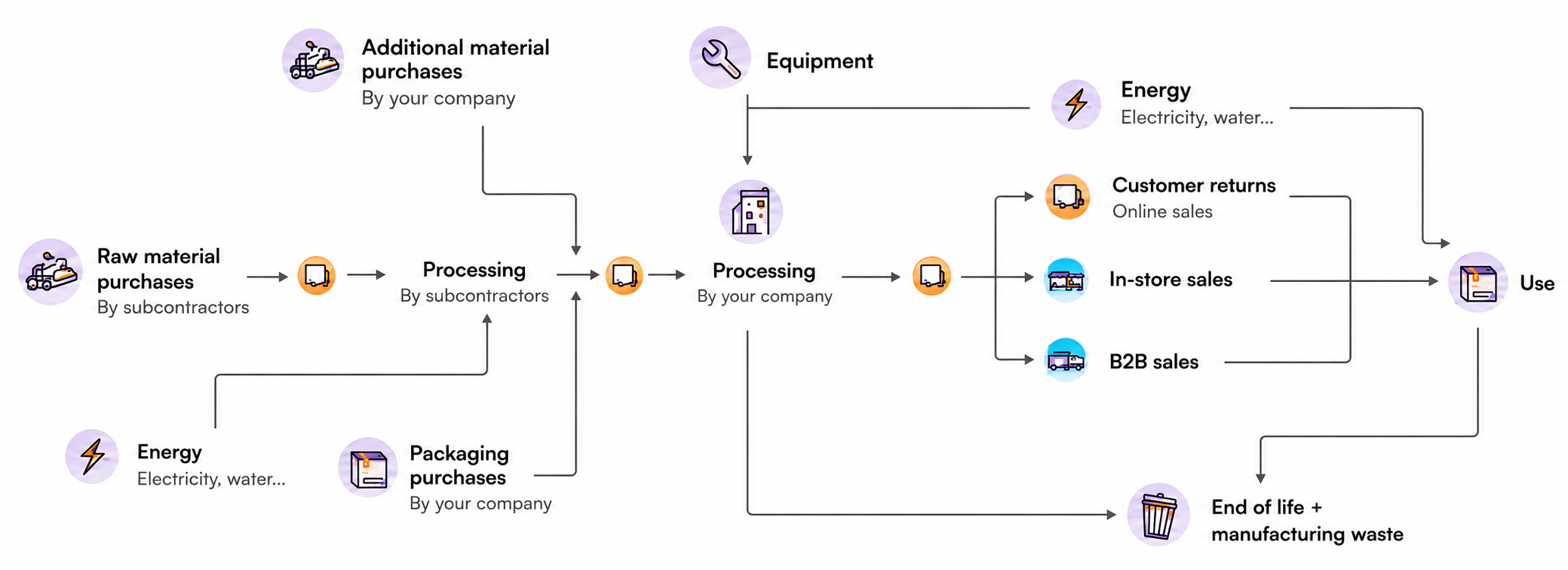
This is how you determine what will be included in the carbon footprint calculation, and therefore which data needs to be sourced.
The second step is to collect the data so it can then be converted into CO2e emissions using emission factors.
This data must reflect all of the company's direct and indirect emissions. This is where Scopes 1, 2 and 3 come in.
Each Scope is divided into sub-categories, also known as "emission items."
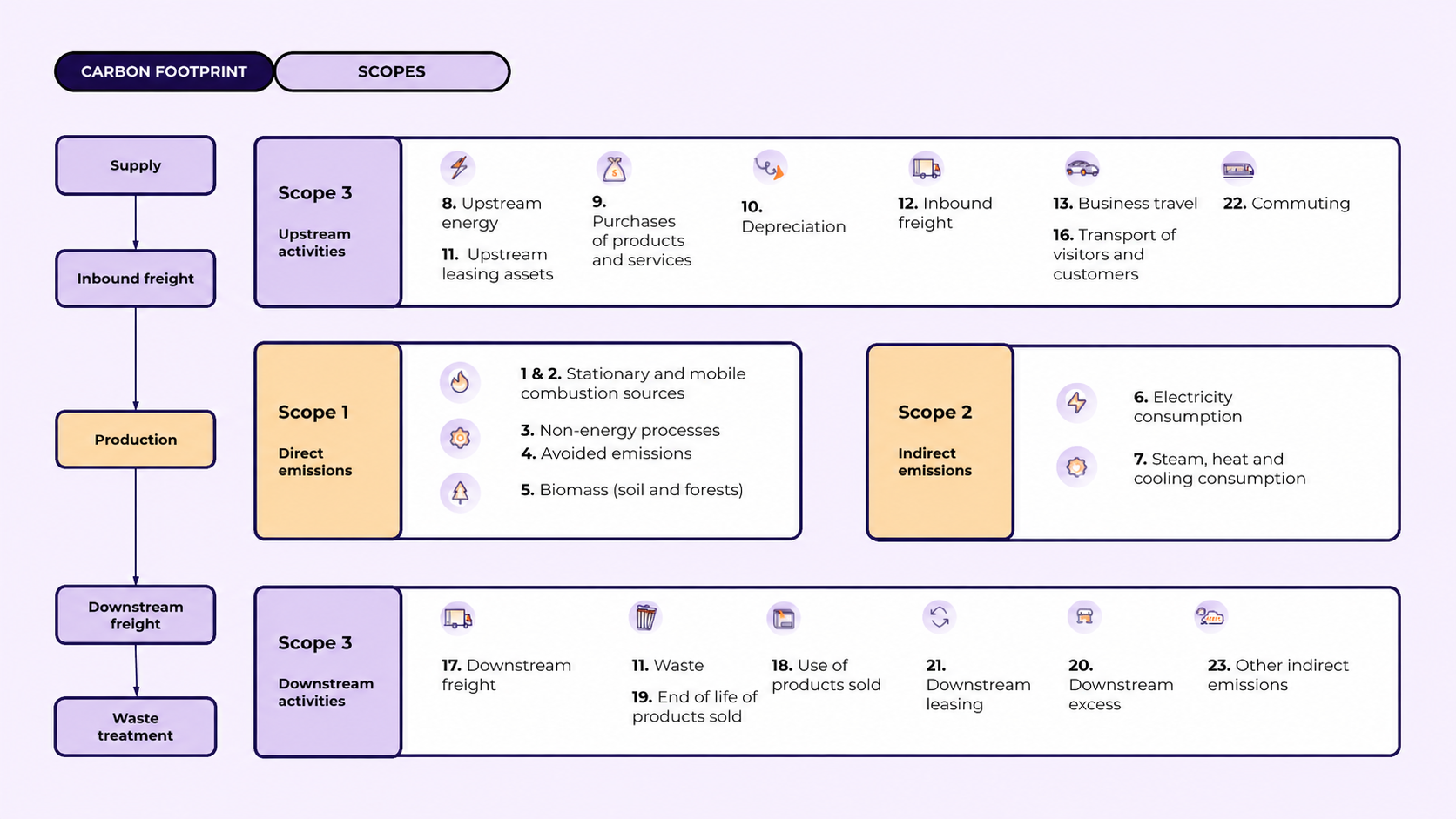
The data collection phase is critical: the more precise and complete the data, the more accurate the carbon footprint will be.
This is where the major challenge of calculating Scope 3 lies: being able to collect and use the best possible data. This depends on the level of information the company has access to, its ability to gather the data, and the significance of the relevant emission item within the company's activities.
How to calculate the carbon footprint of your company? Discover our guide.
1.1 The specific approach
This is the ideal scenario. What's known as the specific approach involves obtaining data specific to the company's suppliers - in other words, supplier-specific carbon data.
Your supplier or transport provider, for example, may be able to give you carbon data specific to the product or service you're purchasing. This data takes the form of kgCO2e per product.
Another possibility is receiving carbon data that isn't specific to the product but to the supplier. If the supplier has carried out its own carbon footprint assessment and reports it relative to its revenue, it can provide emissions per euro spent, so you know that an average purchase from that supplier will emit a certain amount of CO2e: kgCO2e per € spent with the supplier.
Why is the specific approach ideal? Because it's the most accurate. You know exactly what emissions are associated with your purchases of goods and services. Uncertainty is low, which significantly strengthens the accuracy of your own carbon footprint.
"For companies in the industrial sector, we systematically favour the specific approach, particularly for inputs, to avoid artificially inflating emissions. But it's also the hardest to achieve."
Manon Dias, Climate and Environment Consultant, Sami
It's the hardest to achieve because this approach requires access to suppliers' specific carbon data.
That said, an increasing number of companies are calculating their greenhouse gas emissions or carrying out life cycle assessments on their products, either voluntarily or to meet regulatory obligations. This puts them in a position to provide accurate data.
"This is particularly true for freight. Carriers are required to calculate the emissions linked to the transport they provide. So today, all our clients manage to obtain carbon data from their freight providers".
Manon Dias
Large corporations are also often able to provide accurate data, as they are subject to increasingly strict emissions regulations.
But many companies still don't have specific carbon data.
In that case, estimates need to be made to get as close as possible to actual emissions.

1.2 The semi-specific approach
If an approach based on supplier-specific data isn't possible, you need to "step down a level" and opt for a semi-specific approach.
The goal here, even when carbon data isn't available, is to gather as much information as possible from your suppliers in order to estimate the associated emissions.
To do this, you need to work back up your value chain and try to obtain information from your successive suppliers, starting with those closest to you — your tier-1 suppliers.
Traceability is key here: the more accurate the data you obtain, the closer your estimates will be to reality.
The aim is to determine, as precisely as possible:
- the supplier's Scope 1 and 2 emissions, particularly its energy consumption
- the quantity of materials purchased to produce the goods
- transport data for moving the product to your supplier
- the country of origin of the products you purchase - for example, tonnes of steel purchased from a supplier in Turkey, India, or Germany
And repeating this same process further up the value chain.
We then have access to highly accurate emission factor databases, which allow us to associate emissions with the information collected. The carbon footprint of a tonne of steel purchased in India isn't the same as a tonne of steel from Germany.
Let's take the example of a textile company selling a T-shirt.
Rather than settling for an average emission factor for the T-shirt, the idea is to break down each step: what is the garment made of? Where do the raw materials come from? In which country was the spinning done? In which country (or countries) were the manufacturing steps carried out (weaving/knitting, finishing, etc.)? Which suppliers were involved? What is their energy consumption? What mode of transport was used between the different steps and up to delivery?
"We then use reference databases with average emission factors that match this data. In the absence of supplier-specific data, this is the best we can do."
Manon Dias, Climate and Environment Consultant, Sami
This allows us to apply much more accurate emission factors and improve the quality of the emissions estimate for inputs.
However, one limitation of this approach is that it relies on the quality of the data collected. Not all of it is necessarily usable, and some of it introduces a lot of uncertainty into the emissions calculation.
"I have a client who, for part of their inputs, has physical data expressed in m³, which we can't match to emission factors. So based on this data, depending on the density of the materials, we tried to convert it into kg. But this introduces a significant level of complexity and, above all, uncertainty into the calculation. So the question arises of whether to switch to a 100% monetary approach. Uncertainty linked to data is an important factor to take into account."
Manon Dias, Climate and Environment Consultant, Sami
Another significant limitation concerns the calculation of downstream Scope 3 emissions - at least for certain emission items.
This is particularly true for the use of sold products or the end-of-life of sold products. It's still difficult to obtain precise, clear activity data for these items.
"On product use, take the example of the cosmetics sector. To estimate the emissions linked to using a product, you need to be able to determine, among other things, how many times the product will be applied, whether it needs to be rinsed off, and so on. For a textile product, how many times will it be worn, is it ironed, and so on. We also sometimes have clients who sell their products through resellers. If the resellers are based in Europe, we can assume the products will mostly be used in Europe. But that remains a fairly broad estimate."
Manon Dias, Climate and Environment Consultant, Sami
This is also often the case for the end-of-life of products, where it's still very difficult to have a clear picture of what happens to them. In these cases, average data is used.
1.3 The generic approach
In this case, unlike the two previous approaches, nothing is specified. An average impact figure is used instead.
Let's go back to the example of a company selling T-shirts: instead of breaking down the garment and sourcing the most accurate data possible at each stage of the value chain, the generic approach uses an average emissions figure for a T-shirt ready to be sold.
For the end-of-life item, average data is often used, in the absence of more precise, usable data.
And because, in the absence of anything better, average impact data is used, this generic approach is by far the least accurate.
Generic data can take two forms:
- physical data: kgCO2e per kg of finished product
- monetary data: kgCO2e per € of a given type of expense
{{newsletter-blog-3}}
2. Monetary or physical approach?
There are therefore two categories of data that can be used to calculate the associated greenhouse gas emissions:
- financial data, such as invoices or amounts in currency, converted into CO2e emissions. This is known as the monetary approach.
- physical data, such as distances travelled (km) or quantities consumed (kWh, kg, tonnes, etc.), converted into CO2e emissions. This is known as the physical approach.
The monetary approach makes it possible to quickly and easily calculate emissions linked to service expenses, such as purchases of intellectual services, marketing spend, banking services, and professional fees. These expenses can be easily integrated, particularly by using accounting export files to automatically collect and add them.
However, the monetary approach isn't suited to all emissions. For example, for emissions linked to a product's life cycle (raw materials, manufacturing, packaging, transport, use, etc.), the company's energy consumption, employee commuting, and business travel, it's better to use the physical approach.
For instance, in the case of employee commuting, using a monetary ratio based on fuel spend would lead to significant variations in associated emissions due to fluctuating fuel prices - even though actual emissions would remain unchanged.
So while these two approaches are complementary, the physical approach is very often essential to obtain accurate results that reflect the reality of the company's activities.
3. A sector-based approach
For certain sectors of activity, specific methodological considerations need to be taken into account when calculating the various Scope 3 emission items.
It's impossible to list them all here. Two examples:
- Cosmetics
In the cosmetics sector, there is no environmental labelling reference database. It's therefore impossible to rely on secondary data - that is, average impact data.
For the manufacturing stage, as well as upstream and downstream logistics, it's therefore necessary to specify activity data specific to suppliers.
- Textiles
For this sector, the composition of products must be fully specified: precise data on the raw materials used and their quantities is expected, as these vary enormously from one product to another.
In addition, the Impacts database makes it possible to model the emissions associated with dozens of different materials (natural, artificial, or recycled). This allows for accurate emissions estimates.
Beyond that, more general considerations also apply when it comes to sector-specific approaches.
For companies in the services sector, for example, service expenses often represent a significant share of total emissions. For these expenses, the monetary approach is generally favoured today, even though more and more physical data is becoming available to measure emissions more precisely.
“That said, still in the services sector, business travel and commuting items are also often significant. And there, we never use a monetary approach - it wouldn't make any sense. We work with specific or semi-specific data. Visitor travel should also be considered. It's harder to get accurate data, but we generally start from assumptions we build together with the client.”
Manon Dias, Climate and Environment Consultant, Sami
In manufacturing sectors, for inputs, freight, or the end-of-life of products, physical data is almost always used, except in exceptional cases where data is missing, partial, or where emission factors don't make sense.
{{newsletter-blog-2}}
4. How can Scope 3 data collection be improved?
First, it's important to remember that for companies with dozens or hundreds of suppliers, it's often not possible to contact all of them.
You therefore need to start by identifying the most strategic suppliers - those the company buys the most inputs from, and those that are likely to represent the largest share of emissions. It's on these suppliers that you should initially focus your efforts to collect the most accurate data, before gradually moving on to the others.
“You have to keep in mind that for some companies, it sometimes takes 2, 3, or 4 carbon footprint assessments before reaching a point where data collection is robust and accurate across the entire value chain. You need to focus on the most significant items first to reduce uncertainty as much as possible, then refine things gradually. It's work that takes time.”
Manon Dias, Climate and Environment Consultant, Sami
At Sami, to make this collection work easier while still sourcing more accurate data, we've developed dedicated supplier questionnaires.
Companies can then send these directly to all their suppliers to obtain, ideally, specific carbon data, or failing that, life cycle assessment results, or semi-specific data (energy consumption, for example), which allows us to estimate input-related emissions as accurately as possible.
“I often recommend two actions to our clients. First, that the person in charge of the carbon footprint assessment within the company has a good understanding of the company's various departments and processes. This makes exchanges easier and speeds up data collection. Second, I advise companies to set up more suitable data tracking - moving away from a logic where only the cost of purchases is recorded, so they can also track, for example, the weight of their inputs. And here, the company's level of commitment often plays a big role too.”
Manon Dias, Climate and Environment Consultant, Sami
Our other contents on the subject:
- Understand everything about the carbon footprint
- What is the definition of emission scopes 1, 2 and 3
- GHG Protocol: content and differences with the carbon footprint
- Emissions related to electricity consumption in a carbon footprint
- The carbon footprint, an economic performance tool
Decarbonization Mission
Don't miss the latest climate news and stay ahead of regulatory changes


How to build your RFP for a carbon solution in the era of CSRD?
All the information and resources to build your RFP!

Your carbon footprint with Sami
Sami supports you in measuring and reducing your GHG emissions



.jpg)


Les commentaires