


Taking electricity into account is an important element in calculating the emissions of a company, especially for those with activities that generate high electricity consumption.
Calculating emissions related to electricity consumption is, moreover, made somewhat complex by the fact that there are two different approaches in carbon accounting: the so-called location-based approach and the market-based approach.
What are the differences between these two approaches and which one to choose according to the methodology used (Bilan Carbone®, GHG Protocol or regulatory BEGES, for example…) ? What does this change in the calculation of upstream energy emissions in scope 3? How are Power Purchase Agreements accounted for? How Sami works to improve the accuracy of measuring emissions related to electricity?
We detail everything in this article!
1. Electricity, emissions in scopes 2 and 3
In terms of carbon accounting, emissions related to a company's electricity consumption are found in two different scopes:
- Scope 2
Scope 2 includes indirect emissions related to energy and particularly those related to electricity.
What is accounted for here are the so-called indirect emissions, i.e., the emissions induced by the production of the electricity subsequently used within the company.
Two different approaches exist to account for these emissions: the location-based approach and the market-based approach. We will come back to this in detail in a few moments.
- Scope 3
Other emissions related to electricity consumption are found in scope 3, more precisely in the upstream energy item in the Bilan Carbone® or in the item Fuel and energy related emissions in the GHG Protocol methodology.
These are all other indirect emissions related to electricity: the construction of production methods (nuclear power plant, solar panels or wind turbines for example), the distribution of electricity, losses on the network or even the extraction and transport of fossil energies necessary for the production of electricity.
How to calculate the greenhouse gas emissions of your company? Discover our article dedicated to carbon footprint.
2. Location-based or market-based?
On the accounting of emissions related to electricity consumption in scope 2, two different approaches therefore exist: Location-based and Market-based.
2.1 What are the differences?
- The so-called Location-based approach
In this case, emissions are necessarily calculated from the average carbon intensity of the electricity mix of the network where the electricity was consumed. Thus, for a French company, the average French electricity mix will be taken into account, for a German company, the average German electricity mix, etc.
In this approach, the production method of the supplier or the contract (green electricity offer with origin guarantee for example) is not taken into account. The company can therefore not value it in the emissions of scope 2.
- The so-called Market-based approach
In this approach, the emissions taken into account are related to the carbon intensity of the production methods of the supplier or the electricity contract chosen by the company. Failing that, if the origin of the electricity cannot be traced, it is the residual mix that is retained.
For example, in the case of a contract with electricity from wind energy, the emission factor associated will be 0 gCO2e/kWh. Be careful, this does not mean that the total indirect emissions related to electricity consumption are zero. In this specific example, they are zero for the emissions accounted for in scope 2 but they will not be zero for the indirect emissions of scope 3, we will see this a little further down.
In the market-based approach, the different instruments and types of valid contracts (certificates, guarantees of origin, PPAs, etc.) must meet a certain number of criteria (what the GHG Protocol defines as Scope 2 Quality Criteria), summarized in the following table.
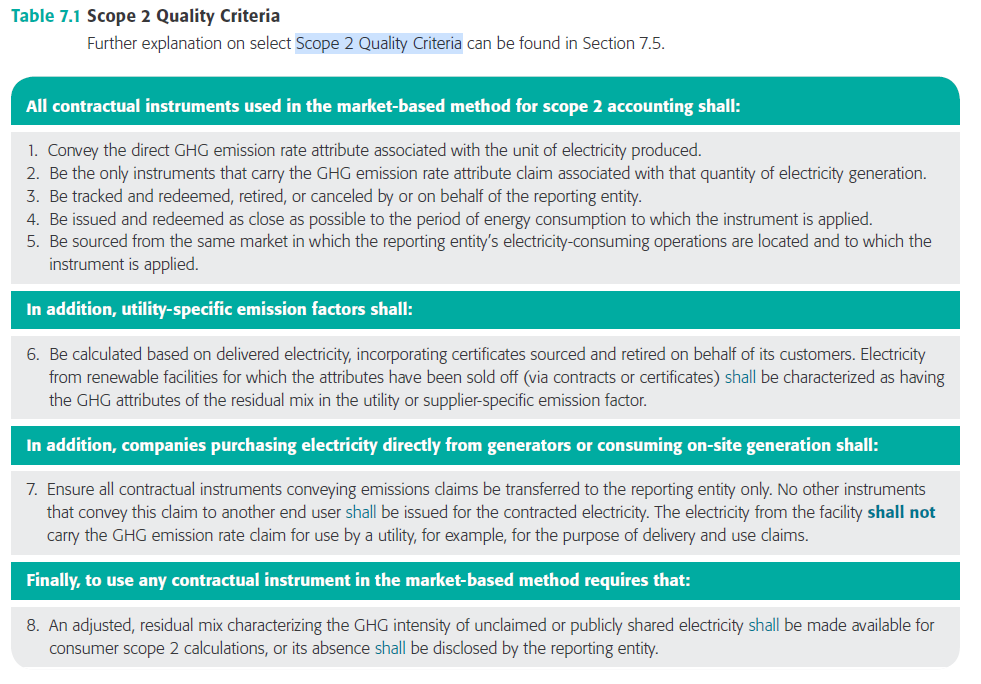
Among the criteria to be respected, there are criteria for the uniqueness of the instrument that can be valued by the consumer (an origin guarantee or a PPA can only be valued for one consumer), spatiality (alignment between the market from which the instrument originates and the market where the consumption is carried out), and temporality (even if for the moment, the GHG Protocol only stipulates to maximize the granularity as much as possible, without imposing a minimum time step, monthly or hourly).
2.2 Which approach to choose?
The choice between these two approaches for accounting for electricity consumption depends on the methodological or regulatory framework in which the company's GES emissions inventory is carried out. Here is a summary of the approach to be retained according to the framework:
| Framework | Type of framework | Approach to accounting for emissions related to electricity consumption |
|---|---|---|
| Carbon Footprint® | Methodology | Location-based |
| GHG Protocol | Methodology | Location-based and Market-based |
| Regulatory Watch | Methodology / Regulation | Location-based |
| CSRD | Regulation | Location-based and Market-based |
This is indeed an obligation and not just a recommendation: the Carbon Footprint® and the Regulatory Watch impose the Location-based approach. The CSRD, having chosen the GHG Protocol methodology for reporting GES emissions, companies will have to assess their scope 2 with both approaches, location and market-based.
2.3 Summary and example
Here is an example of accounting for electricity consumption according to the two approaches:
| Approach to accounting for emissions related to electricity consumption | Rules for measuring scope 2 emissions | Rules for measuring upstream energy scope 3 emissions |
|---|---|---|
| Location-based | Consider the emissions related to the generation of electricity (combustion) from the average electricity mix of the country of consumption: for example 34 gCO2eq/kWh for France in 2022 - Base Empreinte. | Consider the emissions related to the upstream of electricity (line losses, production of production methods, etc.) from the average electricity mix of the country of consumption: for example 18 gCO2eq/kWh for France in 2022 - Base Empreinte. |
| Market-based | Consider the emissions related to the generation of electricity (combustion) from the production methods of the supplier or the electricity contract (for example 0 gCO2eq/kWh in the case of wind energy), or from the residual mix in the case where the origin of the electricity cannot be traced. | Consider the emissions related to the upstream of electricity (line losses, production of production methods, etc.) from the production methods of the supplier or the electricity contract (13 gCO2eq/kWh in the case of wind energy). |
Thus, the choice of the accounting approach also has an impact on the consideration of scope 3 emissions.
In the case of a Market-based approach, if the origin of the electricity consumed is renewable (wind energy for example), the associated emissions for scope 2 are zero because the production of wind energy does not actually generate emissions. On the other hand, the emissions related to the upstream of energy are not zero because it was necessary to build these wind turbines, connect the park to the network, transport this energy, include the losses, etc. In this case, the associated emission factor is 13gCO2e/kWh.
{{newsletter-blog-2}}
3. The particular case of PPAs (Power Purchase Agreement)
Power Purchase Agreements are these private contracts, generally entered into between a renewable energy producer and a consumer, which allow a price to be fixed for a determined period. The PPA market is booming in France, especially since the beginning of the energy crisis and the surge in prices because it is a way for consumers (companies or communities) to commit to renewable energy supply without suffering price volatility and therefore to have visibility on this subject. For producers, this offers an additional source of financing.
How are these PPAs taken into account in the carbon footprint?
3.1 The case of a Physical PPA
A physical PPA is defined by the fact that the electricity from the production park (generally renewable electricity) is purchased (via a third party, supplier or balance responsible) by the consumer to meet their consumption.
We distinguish between physical PPAs on-site (direct connection between the production method and the consumer, this is self-consumption) and off-site (no direct connection between production and consumption).
On-site PPAs are valuable in both the market and location-based approaches.
Off-site PPAs are only valuable in the scope 2 of electricity consumers in the case of a market-based accounting approach.
Note the primacy of an Origin Guarantee (GO) over the PPA: the PPA is only valuable in the scope 2 of a consumer in the two cases below:
- if it is associated with the origin guarantee attributed to the renewable production method (GO bundled with electricity),
- or alone only if there is no origin guarantee or certificate generated and attributed to another consumer (Contracts that convey attributes to the entity consuming the power where certificates do not exist, or Contracts for power that are silent on attributes, but where attributes are not otherwise tracked or claimed).

On the other hand, in the case of a location-based approach, off-site PPAs cannot a priori be valued in the scope 2 of electricity consumers.
3.2 The case of a financial PPA
A financial PPA is defined by the fact that the electricity from the production park (generally renewable electricity) is purchased and then resold by the consumer (via a third party, supplier or balance responsible), and therefore does not meet the company's own consumption that has contracted a financial PPA.
In this case, the financial PPA cannot be valued in the scope 2 of the company, whether it is via the market or location-based approach, but can be valued as avoided emissions (if additionality can be demonstrated, which is a priori well the case for so-called greenfield -associated with the construction of new renewable parks, but is not necessarily the case for so-called brownfield -associated with existing parks, for example at the end of the purchase obligation).
For reminder, avoided emissions, this is the indicator that allows to calculate the contribution of the company (through its activities, its products or its services) to the reduction of GHG emissions outside its scope of activity. These avoided emissions are evaluated by comparing the scenario with the low-carbon solution deployed and a reference scenario without low-carbon solution.
Avoided emissions are not included in the carbon footprint, they cannot be subtracted from the total GHG emissions of the organization studied. On the other hand, they can be calculated separately to allow the company to have figures on its impact in terms of decarbonization outside its perimeter.
Avoided emissions correspond to pillar B of the Net Zero Initiative (NZI) launched by the firm Carbone 4.

Here is a summary of how the different PPAs are integrated according to the approaches:
| Contract type | Location-based approach | Market-based approach |
|---|---|---|
| Physical PPA | Not valuable in the scope 2 location-based (unless on-site), valuable as avoided emissions in case of additionality (pillar B NZI) | Valuable in the scope 2 market-based (provided that the Scope 2 Quality Criteria are met) |
| Financial PPA | Not valuable in the scope 2 location-based, valuable as avoided emissions in case of additionality (pillar B NZI) | Not valuable in the scope 2 market-based, valuable as avoided emissions (pillar B NZI) |
The Net Zero Initiative (NZI) synthesizes the approach of accounting for induced and avoided emissions depending on the purchase of GO, PPA or in the case of self-consumption, for consumers.

4. How Sami works to refine the calculation of emissions related to electricity consumption
As seen above, in the so-called Location-based approach (and even with the Market-based approach when the origin of the electricity cannot be traced), the emissions related to electricity consumption are estimated using the average electricity mix of the country of consumption. For France, we have annual emission factors for this.
However, it should be known that this emission factor is an average EF that uses the production and consumption data of the last 4 years in France.
For companies whose electricity consumption has little weight in total emissions, this estimate provided from the average EF of the French electricity mix does not pose a problem. On the other hand, for an industrial customer with high electricity consumption, knowing with much greater precision the emissions associated with it becomes an important issue.
To achieve this, we perform a calculation that is based on two data sources:
- the customer's electricity consumption, on an hourly basis throughout the year, collected (after the company's agreement) from Enedis.
- the emission factor of the French electricity mix on an hourly basis throughout the year. Data retrieved thanks to our partner Electricity Maps.
This allows us to match, at each hour, the company's electricity consumption with the observed electricity mix.
Indeed, the emissions associated with the electricity mix vary significantly depending on the mode of energy production, imports/exports with neighboring countries and therefore vary according to the time of day, the weather or even the time of year.
This new data allows us:
- to gain much more precision in measuring the emissions associated with the company's electricity consumption
- to establish an action plan that is also much more precise: load shedding at certain times, shifting consumption or self-consumption of renewable energies at the most carbon-intensive times, distribution of consumption according to the seasons...
- to calculate avoided emissions. For example, in the context of electricity production with solar panels, we can match, at each hour of the day, the carbon intensity (in kgCO2e/kWh) of the electricity produced on the grid with that of solar energy. And then obtain the avoided emissions in CO2e. This can be done in a self-consumption context but also in the case of a contract with a supplier or a PPA in order to estimate the avoided emissions allowed by this renewable energy supply.
{{newsletter-blog-3}}
Decarbonization Mission
Don't miss the latest climate news and stay ahead of regulatory changes

Are you looking for training on carbon accounting?
Sami offers an 18-hour training course to measure the GHG emissions of an organization

Do your carbon footprint with Sami
Sami accompanies you in measuring and reducing your GHG emissions



.jpg)


Les commentaires