
AI in the company: what environmental impact and how to control it?

Climate Editor
Artificial intelligence (AI) is no longer just a technological curiosity; its use within companies has exploded in recent months and has become an important driver of productivity or innovation.
However, behind tools like ChatGPT, Mistral or Gemini, lies a massive and energy-intensive physical infrastructure. For companies, the challenge is twofold: avoid AI becoming the "dead point" of the carbon strategy and preventing the achievement of objectives, while exploiting its innovation potential.
In this article, we return to the environmental impact, and in particular the carbon footprint, of AI, the method for calculating it and the existing levers that make it possible to control this impact.
📺 Do you prefer the video format? This article covers the key points of our latest webinar on this topic. Find the replay here.
The speakers of this webinar:
- Tanguy Robert, co-CEO of Sami
- Agathe Gourhannic, Sustainability Consulting Manager, fifty-five
- Grégory Lebourg, Global Environmental Director, OVHcloud
1. What is the impact of AI on the environment?
The environmental impact of artificial intelligence is often misunderstood because it is hybrid. It is not just a matter of "consuming electricity", but of mobilizing resources at every stage of the value chain.
1.1 The carbon impact of AI
The carbon impact related to AI is distributed between the emissions of data centers, the network and the devices for using AI. However, it is indeed the emissions related to data centers that weigh the most, and by far.
Thus, in the life cycle analysis of the Large Model 2 published by Mistral AI in July 2025, the emissions related to the devices or equipment of the end users represent only 3% of the total emissions and the emissions related to network traffic less than 1%. More than 95% of greenhouse gas emissions are therefore at the level of data centers, notably because of their electricity consumption. It is on this point that we will focus.
- The manufacturing
Beyond the electricity consumption for the use of AI (training of the models, daily use…), it is not necessary to forget to take into account the carbon footprint linked to the manufacture of the data centers themselves and to the manufacture of the necessary components (servers, processors…).
According to the report of the Shift Project published in October 2025, the manufacture represents approximately 25% of the total emissions of the data centers, against 75% for the usage phase.
And within this manufacturing phase, the IT position (servers, processors...) accounts for around 75% of emissions against 25% for the infrastructure part (construction of data centers...).
- The usage phase
It is indeed this phase that represents the most emitting part of AI, at the level of data centers and therefore at the global level as well.
Let's take up the study published by Mistral AI on its Large Model 2: the training of the model and the inference phase, i.e. the daily use by users, represent 85.5% of the total emissions of the model, after 18 months of use.
The training of Mistral Large 2 would have thus generated the emission of 20.4 ktCO2e, i.e. 9700 A/R Paris-New York by plane.
The reason is simple: training models requires colossal computing power and therefore mobilizes a large number of processors (GPU) that consume a lot of energy. It is also necessary to continuously cool the data centers, which again generates significant energy consumption.
The more the energy mix of the region in which the data center is located is carbon-intensive, the more the emissions are significant, hence the importance of being attentive to this criterion, we will see this a little later.
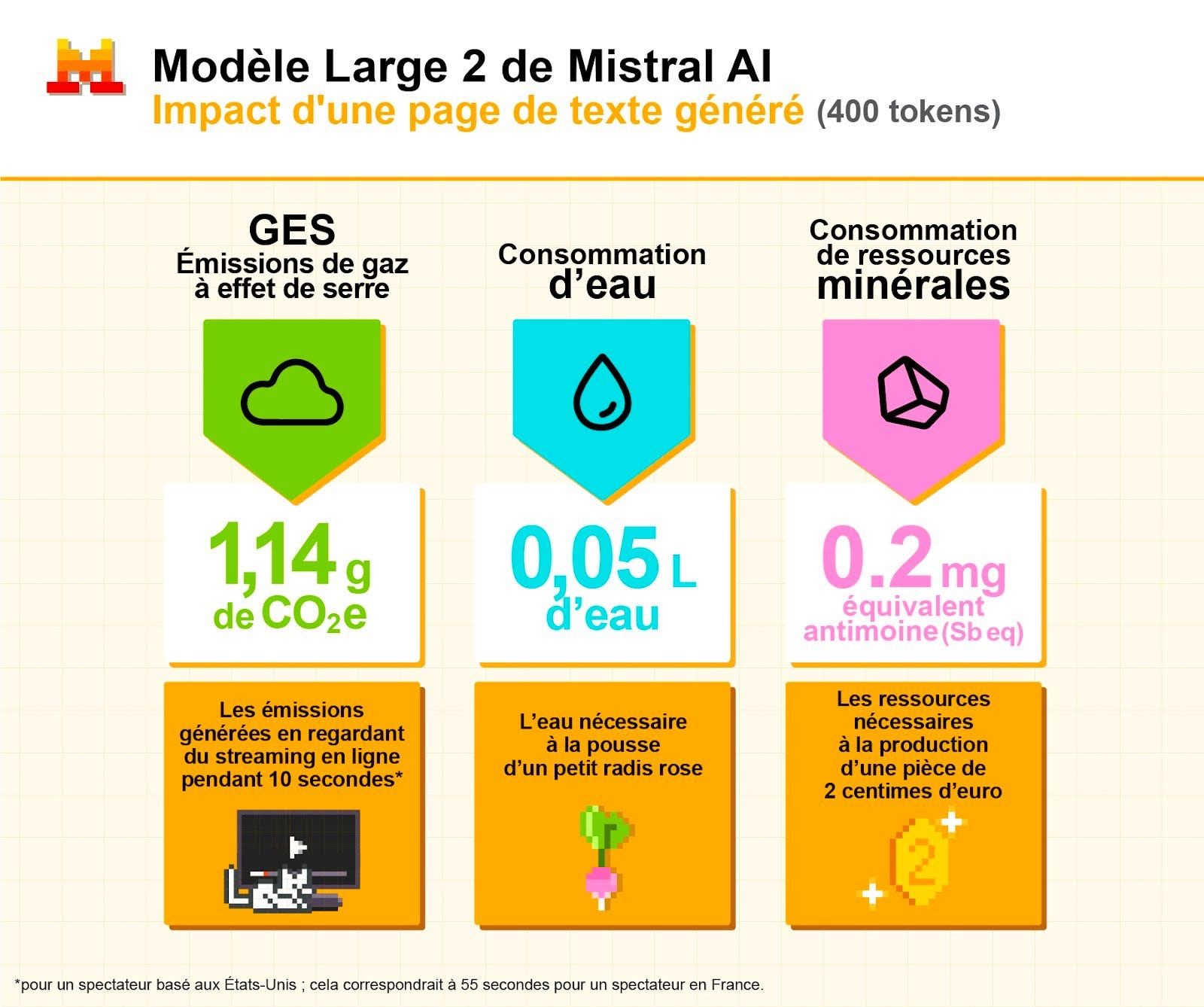
During the usage phase of the model by users, each request weighs little. Mistral estimates, for example, that a generated text page (400 tokens) represents 1.14 gCO2e. On the scale of a request, the carbon footprint is therefore anecdotal. The problem is that you have to multiply this impact by the number of requests and by the number of users.
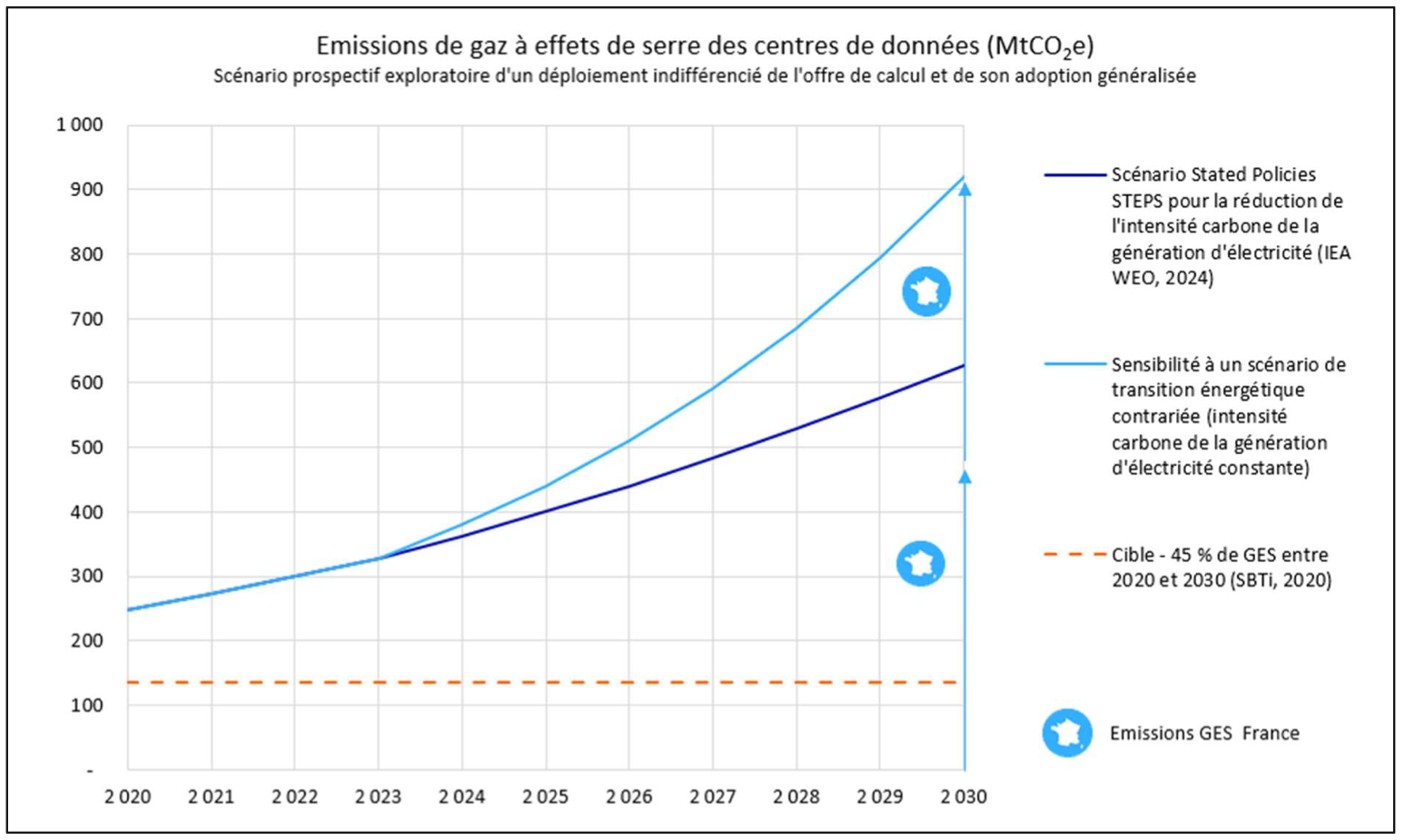
According to the Shift Project, the global electricity consumption of data centers could be multiplied by nearly 3 between 2023 and 2030. And the share of AI in this electricity consumption would go from 15% today to 35% in 2030.
As a result, the data center industry could see its greenhouse gas emissions increase by 9% per year until 2030, reaching 920 MtCO2e, which is twice the annual emissions of France.
1.2 Other than Carbon Environmental Impact
CO2 emissions are not the only environmental impact caused by the use of artificial intelligence.
Two other major impacts need to be considered.
- Water consumption
According to estimates from the International Energy Agency, the IEA, the AI sector consumed approximately 560 billion liters of water in 2023, surpassing global bottled water consumption. And this water consumption could double by 2030 to reach approximately 1200 billion liters.
Artificial intelligence indeed requires enormous amounts of water. Three major uses are involved:
- water needed for electricity production: this represented, according to the IEA, two-thirds of the AI sector's water consumption in 2023.
- water needed for direct cooling of data centers: about ¼ of total water consumption
- water needed for the manufacture of semiconductors and chips
Google's data center water consumption thus increased by 14% in 2023, reaching 24 million m3. The increase is even 22% for Microsoft.
- Metal consumption
Graphics processors (or graphics cards) that power servers intended for AI are composed of about twenty metals, including copper, iron, or silicon.
With the explosion of the use of artificial intelligence, the manufacture of graphics cards and other server components is expected to explode.
And the manufacture of these components is not only metal-intensive, it is also energy and water-intensive, as seen previously.
2. How to calculate this impact within your company?
At Sami, we observe that 2025 is the first year when the use of AI begins to be integrated into the measurement of companies' carbon footprint.
How to calculate it?
2.1 Recently published results
Let's revisit the results recently published by Mistral AI and Google for Gemini.
The French Mistral claims the first complete life cycle analysis of an AI model, the Large Model 2. Here is the impact of the AI assistant Le Chat for a 400-token response:
- 1.14 gCO2e
- 45 mL of water
- and 0.16 mg of Sb eq (abiotic resource depletion indicator)
A few weeks later, Google released a report on the carbon impact of Gemini queries on CO2 emissions, energy consumption, and water consumption.
Here, according to Google, is the impact of a median text prompt in the Gemini applications:
- 0.03 gCO2e
- 0.26 mL of water
- 0.24 Wh of energy
In other words, a prompt on Gemini would be 38 times less emissive than a prompt on Mistral AI and 173 times less water-consuming.
Such a difference is “impossible” observes Grégory Lebourg. Whereas Mistral AI's impact results appear “coherent”, with “serious and well-done work”, the results of queries on Gemini are very low. And for good reason, Mistral and Google did not apply the same methodological choices. It is precisely on this point that one must be very careful.
For example, in Google's study on energy, electricity-related emissions were accounted for as "Market-based" and not "Location-based". This means that the energy mix of the country or region where the data centers are located was not taken into account. This would significantly increase the total emissions associated with the use of Gemini.
2.2 What factors should be considered to calculate emissions related to the use of AI?
How to get the most accurate estimates possible regarding the carbon footprint of your AI usage?
To do this:
- the location of the data center
- the model used
- the number of queries
- the size of the query results
Note that cloud service providers, such as OVHcloud, are normally now able to provide the emissions associated with the services consumed by their customers, including AI platforms. This is what OVH has been doing for 3 years with a carbon calculator.
With this data, we are able to calculate the footprint of AI within the digital carbon footprint and therefore integrate it into the company's carbon balance.
{{newsletter-blog-3}}
3. How to control the impact of AI in the company?
3.1 What solutions for enterprise users?
The first question to ask is "Why?" In other words, what is my need and is the use of artificial intelligence necessary to meet it?
Many cases do not require artificial intelligence and therefore investing in this type of response.
For a controlled use of AI, the first answer is therefore to select the right use cases.
Here are the other levers available to companies:
- choose the location of the data center
Data centers located in regions or countries where the energy mix is largely decarbonized consume, in fact, much less than those powered by coal, for example. Choosing data centers in France thus considerably reduces the emissions associated with the use of AI.
This is particularly the case for companies that are in a "AI deploy" logic and will have to do calculations, do deep learning autonomously on cloud platforms. They can then choose the most efficient and least impactful ones. On GPU platforms to train a model, "you will reduce CO2 emissions by 85% if you do it on a platform in Canada rather than in Poland", according to Grégory Lebourg.
- choose the right model
Not all needs require a "giant" model. For simple tasks (classification, summary), a compact model is much less energy-intensive than a generalist model, for an identical result.
- train employees
The multiplication of queries will, on the scale of a company, considerably increase the environmental impact of AI.
Training can be used, for example, to improve the prompts used by employees to obtain the desired result in one query instead of 5 or 6 requests. The more precise the prompt, the more the carbon footprint will be reduced.
It is also a matter of informing employees about the environmental footprint of AI and insisting on its reasoned use. The generation of images to respond to trends on social networks, for example, is responsible for significant and largely avoidable emissions. According to some studies, each image generated could represent between 2 and 5 liters of water evaporated for cooling.
3.2 What solutions for data centers?
Several technical solutions exist to limit the consumption of data centers.
The first is water cooling. The energy efficiency of the data center is then much better.
Another technology that can be used: immersive cooling. This allows servers to be placed in a non-conductive fluid, oil.
Furthermore, from a technological standpoint, the performance of graphics cards and, more broadly, semiconductors is significantly better now. "When looking at Nvidia's range, the new generations are 120 or 130 times more efficient than those from two years ago" illustrates Grégory Lebourg in our webinar.
For users, it is also now possible to ask the cloud service provider to process requests based on the energy mix available in the country and thus run the servers when the mix is least carbon-intensive, for example when renewable energy production is high. This only works for AI uses (and there are many) that do not require immediate results.
Conclusion
AI can be an accelerator for your business, but its deployment should not compromise your decarbonization trajectory and jeopardize your greenhouse gas emission reduction goals. The good news is that it is possible to control the carbon impact of AI by carefully selecting your use cases and the right deployment parameters.
If you wish to delve deeper into these concepts, we invite you to watch the full replay of the webinar:
👉 Watch the Replay: AI in Business, What is the Carbon Impact?

Measure the carbon footprint linked to the use of AI
Sami helps you measure the carbon footprint of your AI usage and integrates it into your overall carbon balance

On the same topic
More articles to explore, written with just as much passion

.png)