


Climate change is disrupting our lives. It also disrupts economic models and the daily operations of businesses: extreme weather events are multiplying and disrupting supply chains, most economic actors are seeking to reduce their CO2 footprint, consumers are favoring responsible products, and regulations on these issues are tightening year by year.
How to evolve in a world where the carbon constraint is becoming increasingly strong? How to adapt your business model? What are the risks and opportunities? To these questions, many answers but a prerequisite: the realization of a carbon footprint. Because it allows to assess its dependence on carbon, to identify greenhouse gas (GHG) emissions and then to reduce them, the carbon footprint is today an essential management tool.
Carbon footprint, Bilan Carbone®, climate strategy, what are the differences?
The carbon footprint is actually the inventory, the photograph of all GHG emissions, direct and indirect, of a company. It is the starting point of any climate strategy.
And this is where the carbon footprint comes into play since it is in fact the name of a method used to calculate this carbon footprint. The Bilan Carbone® was officially launched in 2004. Objective: to create a universal tool for measuring the carbon footprint of an organization. The methodology is quickly deployed and becomes the reference tool. This is how the Bilan Carbone® enters common language.
But other carbon footprint measurement methodologies exist, notably the GHG Protocol. We also talk about BEGES, the greenhouse gas emissions inventory, for the mandatory balance sheet of companies with more than 500 employees and communities of more than
50,000 inhabitants.
The 4 main reasons to do your carbon footprint

An ethical issue
Halve global CO2 emissions by 2030. This is the goal recalled in the latest IPCC report in order to limit the rise in temperatures to 1.5 degrees by the end of the century. The impacts of global warming are accelerating, we see it every year but emissions, they are not decreasing fast enough. At the current rate, the 1.5 degrees will be crossed during the next decade, the 2 degrees around 2050 to reach 3 degrees in 2100, causing devastating, generalized, sometimes irreversible impacts.
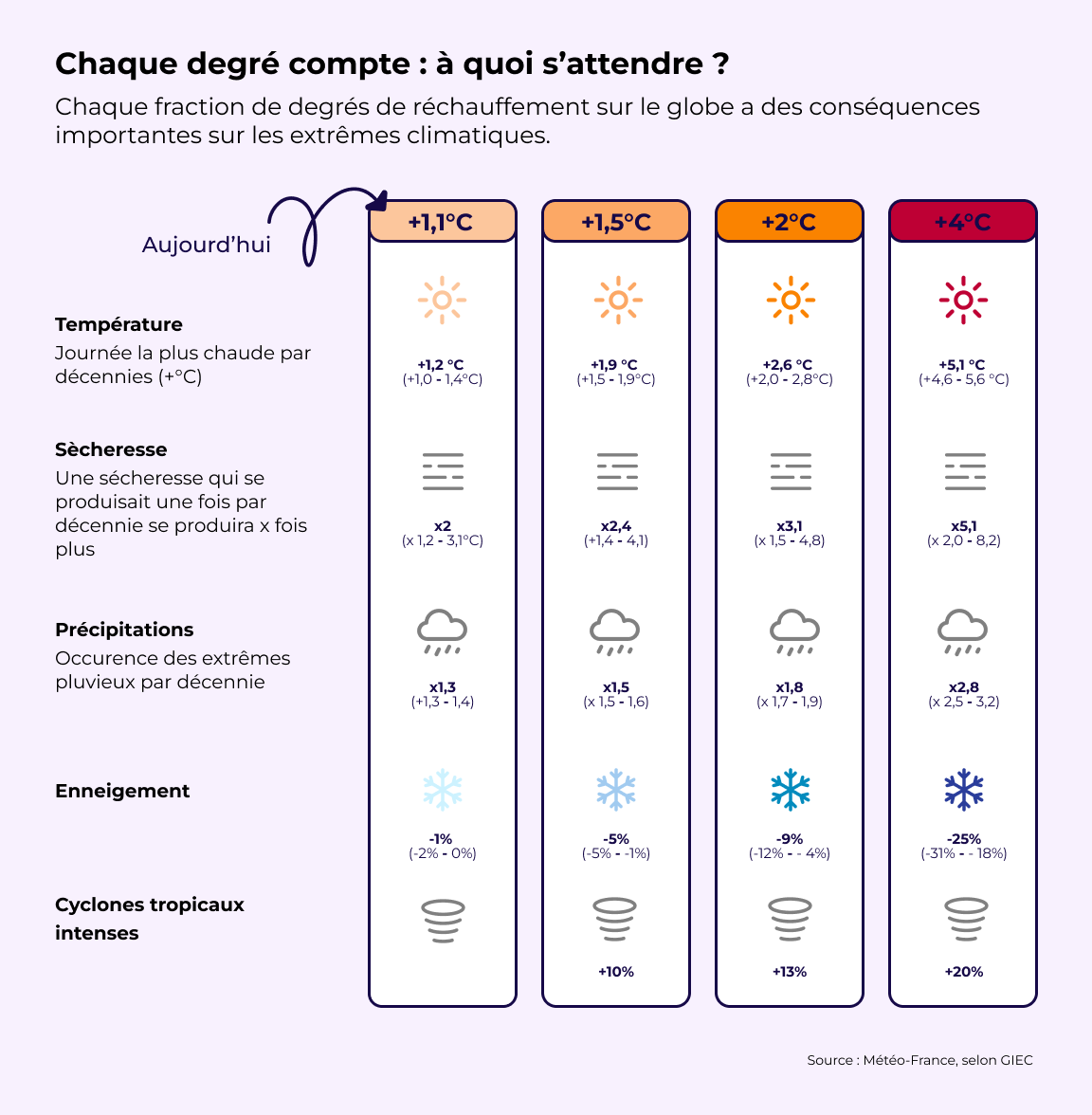
But this worst-case scenario is still avoidable. Solutions exist, they are numerous. And companies have a key role to play.
This role is to do their part against climate change. It is to succeed in reducing its greenhouse gas emissions thanks to ambitious action plans. The Science Based Targets initiative (SBTi) thus indicates a trajectory of reduction of GHG emissions of 4.2% per year for companies in order to respect the objective of the Paris Agreement, namely to limit the rise in temperatures to 1.5 degrees.
Which are the most emitting activities? Which product, which raw material, which subcontractor emits the most? Without a complete carbon footprint (scope 1, 2 and 3), these questions remain unanswered. It is then very complicated to develop a strategy to reduce GHG emissions. The carbon footprint is the management tool that will allow to direct the financial and human resources of the company towards the most effective reduction actions. We only reduce what we know.
A strong competitive issue
Risks to economic performance
In a world where CO2 is no longer welcome, not integrating it into its strategy creates a threat to the economic performance of the company. "Doing a carbon footprint is a first step to pilot and manage the climate-related risks to which a company is exposed", explains Guillaume Colin, Head of Climate Expertise at Sami. And they are numerous.
- Risks related to stakeholders
This is particularly the case for the company's customers, consumers or economic partners. More and more consumers are attentive to the carbon and environmental footprint of the products they buy. In this study on responsible consumption published in 2021 by ObSoCo, the Observatory of Society and Consumption, 61% of French people considered the environmental situation very worrying, to the point of calling for radical changes in order to produce and consume less but better.
Moreover, an increasing number of companies are asking their suppliers to produce at least the carbon footprint of their activity. The carbon footprint is becoming a criterion in an increasing number of tenders, public or private. Let us mention the SNCF which has integrated since this year for its 55 largest suppliers a price per tonne of carbon in its tenders in order to monetize their GHG emissions.
61% of procurement departments of large companies (more than 5000 employees) had objectives related to sustainable development or CSR in 2022.
- Financing risks
The investment funds are increasingly numerous in requiring companies in their portfolio at least the calculation of their carbon footprint, for others the implementation of a strategy to reduce emissions. This is the case of our client, Founders Future but also for example Meaning Capital Partners or Serena Capital.
Many other financial players now exclude companies that operate in very carbon-intensive sectors. This is what the Banque de France has just announced, which will exclude from its portfolios by 2024 any company that develops new fossil fuel extraction projects.
- Market risks
"Carbon prices are rising, details Guillaume Colin. If a company wants to know its exposure to this financial risk of carbon, here too the starting point is to know its emissions. If it does not know to what extent its value chain is carbon-intensive, it risks paying much more for its raw materials or being less competitive downstream because these carbon taxes will erode margins."
Technological risks are also added with many low-carbon innovations that are emerging. With the risk here again of being late and losing market share.
- Physical risks
49% of the CEOs interviewed in this study by Accenture and the UN Global Compact acknowledge that their companies are already suffering the impacts of extreme weather events, notably through disruptions in their supply chain. Examples around the world are multiplying.
- The floods in Thailand in 2011 shut down many factories of international automobile manufacturers, the production of hard drives or electronic chips was interrupted.
- In 2018, the chemical giant BASF had to stop the activity of one of its plants in Germany which no longer received enough raw materials, the river traffic on the Rhine being slowed down by the very low level of the river.
- Last example, in 2021, Taiwan experienced its worst drought in 56 years, leading the government to restrict access to water for many industrialists including TSMC, the world's largest semiconductor manufacturer. It had to reduce its water consumption by 10%. Last March, new drought wave, TSMC activated its crisis plan again in order to limit the impact of water restrictions on production.
These different risks, companies can materialize them financially from their carbon footprint. "A company can create models thanks to the carbon footprint in order to estimate financially how much it risks losing if companies align themselves with trajectories compatible with the 1.5 degree target", analyzes Guillaume Colin.
The opportunities
For the same reasons that not engaging in a transition approach exposes the company to many risks, doing so offers economic benefits: gaining market share; access to financing; competitive advantage in tenders; etc... This also allows you to be able to benefit from labels or RSE certifications, such as Ecovadis or B-Corp.
Moreover, by identifying the main sources of emissions of the company, the latter is able to act quickly on the control of the associated costs, with in some cases rapid savings. This is particularly the case with energy consumption. ADEME indicates for example that lighting represents 20% of the electricity consumption of a building and that it is possible to reduce it by 40 to 66%.
Beyond the control of energy consumption, the more global approach of eco-design of products leads to better economic performances for a company. This is the result of a study again by ADEME published last year. The ecological transition agency notes a systematic increase in the turnover of the companies concerned thanks to new markets and a higher volume of sales. The reputational benefit is also high.
Competitive advantage, cost control, risk management. In a study published in 2022, the Ernst and Young firm surveyed more than 500 business leaders. 69% of them report that they derive higher than expected financial value from their climate initiatives. Financial value but not only. They also observe the creation of “customer value”, on customers, brand image, and “employee value” on employee satisfaction and recruitment.
Employer brand and legal risk
Again, the prospect of engaging in a carbon footprint and more broadly a strategy to reduce greenhouse gas emissions can be analyzed under the opposition Risk/Opportunities. This is particularly the case for the image among its employees, current or future.
According to this study published by Unedic last April, 84% of French workers indeed want a job in line with the climate challenge and a quarter of workers consider changing jobs or companies to bring their professional life into line with their ecological concerns. More and more graduates from prestigious schools are thus refusing to work for companies whose actions are deemed harmful to the climate. We have seen this recently at HEC and AgroparisTech.
The risk is also legal. Lawsuits against companies accused of not implementing a realistic emissions reduction strategy are multiplying. BNP Paribas has just been sued by three NGOs and Total is being attacked from all sides for its role in the climate crisis. On this subject, the European text on the duty of vigilance provides for the mandatory implementation of transition plans for companies. These would be civilly responsible if this is not done.
Regulatory
French and European laws are becoming increasingly stringent on this matter. Thus in France, a greenhouse gas emissions report is mandatory every 4 years for companies with more than 500 employees. But this law is still little applied.
However, an increasing number of companies will be subject to the mandatory production of a carbon footprint. The European directive on the CSRD in particular integrates climate issues into the extra-financial reporting of all companies with more than 250 employees.
Finally, the Climate and Resilience Act voted in 2021 provides for environmental labeling on certain products. An experimental phase will begin early next year and will concern textile and food products. Companies will then have to display on their product an environmental score, including GHG emissions, impacts on biodiversity and water and other natural resource consumption.
Obstacles and our answers
“This is a significant cost”
True, carrying out the calculation of your carbon footprint and implementing a strategy represents a cost. But for all the reasons indicated previously, this cost is an investment.
There is also a public funding scheme for the production of a carbon footprint: this is the Diag Décarbon’Action. Since July 1, 2024, out of a total price of 10,000 euros, the remaining amount to be paid by companies is 6,000 euros.
Only companies that have never measured their carbon footprint are eligible.
“We don’t have the time”
Financial and human resources are precious and limited. This is precisely why carrying out a carbon footprint is crucial: it enables resources to be allocated effectively to the most emitting sectors of the company. But before that, the production of a carbon footprint does indeed take time. The solution developed by Sami precisely offers support and a platform designed to facilitate and accelerate the measurement of the carbon footprint and the co-construction of the action plan.
Industrial companies, the hydrocarbon or transport sectors are not the only ones to emit greenhouse gases! Any economic activity generates emissions, in the digital sector, purchases, travel. And in the face of the climate crisis and the urgency of reducing emissions, every tonne of CO2 avoided counts.
The direct impacts of climate change and the low-carbon transition pose numerous risks to the economic model of companies. But this transition also represents opportunities. For companies, committing to a carbon footprint and then a process of reducing their GHG emissions constitutes a competitive advantage, in the short term for some, in the medium or long term for all the others.
{{newsletter-blog-3}}
Decarbonization Mission
Don't miss the latest climate news and stay ahead of regulatory changes


Do your carbon footprint with Sami
Sami accompanies you in carrying out your carbon footprint and implementing your climate strategy



.jpg)


Les commentaires