How to electrify and decarbonize your fleet of vehicles?

Climate Editor
Faced with the climate emergency and new regulatory requirements, the electrification of corporate fleets has become a major issue for French organizations.
Since March 2025, the removal of mandatory quotas for low-emission vehicles in favor of an incentive tax marks a turning point in the government's approach. This regulatory evolution, coupled with technological advances and the progressive reduction in costs, places companies in front of a strategic choice: suffer tax penalties or seize the opportunity to decarbonize their vehicle fleet.
Beyond financial and regulatory aspects, this transition represents an essential lever to reduce the carbon footprint, improve RSE performance and prepare for the future of professional mobility.
How to decarbonize your fleet? What are the possible aids? We explain everything in this article.
1. What does the law say?
The Mobility Orientation Law (LOM), voted in 2019, aimed to engage and accelerate the decarbonization of mobility and in particular the road sector.
And to achieve this, this law included, among many measures, objectives for the transition of the professional automotive park, in particular company fleets.
The LOM thus introduced obligations to acquire low-emission vehicles when renewing the vehicle fleet. The obligations voted in 2019 were then strengthened by the climate and resilience law of 2021.
Companies managing a fleet of more than 100 motor vehicles had to acquire, during the annual renewal of their fleet, a minimum proportion of low-emission vehicles, according to the following schedule:
- 10 % as of January 1, 2022;
- 20 % as of January 1, 2024;
- 40 % as of January 1, 2027;
- 70 % as of January 1, 2030.
However, this obligation, set out in Article L224-10 of the Environmental Code, was repealed by Article 28 of the Finance Act of February 14, 2025.
Thus, since March 1, 2025, the LOM obligation no longer exists. It has been replaced by an annual incentive tax relating to the acquisition of low-emission light vehicles.
This tax system is codified in Articles L. 421-99-1 to L. 421-99-9 of the Code of duties on goods and services.
This tax applies to companies with a fleet of more than 100 vehicles. It is calculated by multiplying the penalty amount per vehicle, the number of missing low-emission vehicles and the annual renewal rate of high-emission vehicles of the company.
Here is the detail of the 3 elements used to calculate the tax:
- the number of missing vehicles: this is the difference between the actual number of low-emission vehicles present in the fleet and the target set by the law. These target objectives are as follows:
| Year | 2025 | 2026 | 2027 |
|---|---|---|---|
| Objective | 15% | 18% | 25% |
| Year | 2028 | 2029 | 2030 |
|---|---|---|---|
| Objective | 30% | 35% | 48% |
- the penalty amount per vehicle: this is the penalty per missing vehicle. The amount will evolve progressively.
| Year | 2025 | 2026 | As of 2027 |
|---|---|---|---|
| Penalty amount | 2000 euros | 4000 euros | 5000 euros |
- the annual renewal rate of high-emission vehicles: the number of high-emission vehicles renewed during the year in question.
Calculation example
Take the example of a company with a fleet of 500 vehicles, including 25 low-emission vehicles at the end of 2025, and which renews its fleet in 2025 with 50 new high-emission vehicles.
Here's how to calculate the annual incentive tax:
- Amount of the penalty per missing vehicle: 2000 euros, this is the amount for the year 2025.
- Number of missing vehicles: the target for 2025 is 15%, it should therefore have 75 low-emission vehicles. 75 - 25 = 50 missing vehicles.
- annual renewal rate of high-emission vehicles: 50 vehicles renewed/500 vehicles in total = 10%.
Amount of the tax: 2000 ✕ 50 ✕ 10% = 10 000 euros
{{newsletter-blog-3}}
2. Why decarbonize your fleet of vehicles?
2.1 Reduce your greenhouse gas emissions
The transport sector remains today the sector that emits the most greenhouse gases (GHGs) in France, with approximately ⅓ of national emissions.
According to official figures, between 1990 and 2023, the level of GHG emissions from transport increased by 2.8% while emissions from all other sectors decreased by 41%.
94% of total transport emissions come from road transport and 53% for passenger cars alone.
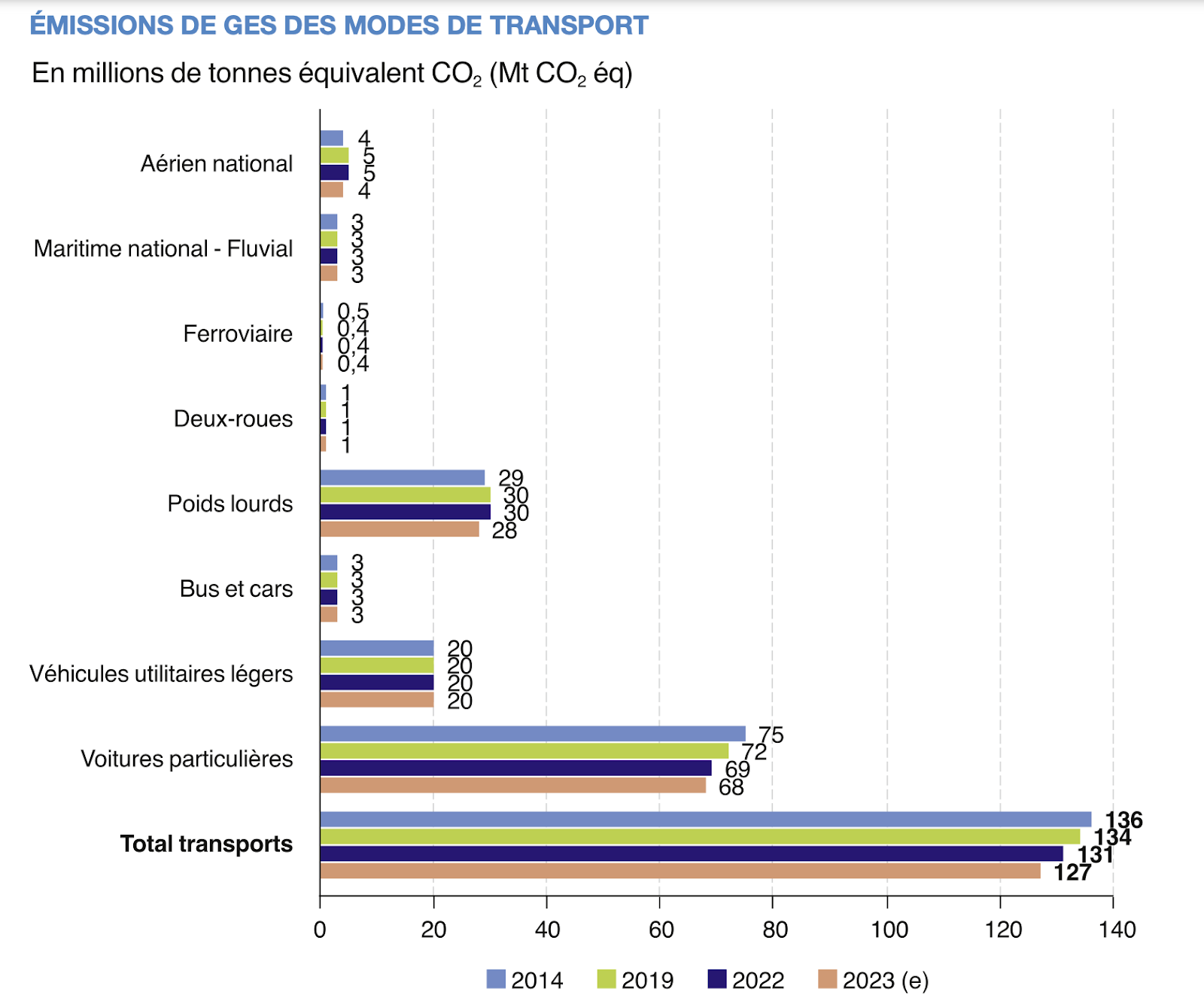
Hence the importance of decarbonizing the sector and accelerating the electrification of the French automotive fleet, and in particular corporate fleets.
Yet, despite the regular controversies, the figures are very clear.
According to data provided by the Ademe, an electric car emits on average 103g of CO2e per km, i.e. between 2 and 3 times less greenhouse gases than a thermal car.
So much so that, even if the production of an electric car is more emitting than a thermal car due to the manufacture of the battery, it “suffices” to travel between 30,000 and 50,000 km for the electric car to be more interesting from a GHG emissions point of view. Over a lifetime of 200,000 km or more, the reduction in emissions is significant and even colossal on the scale of a corporate fleet of a hundred or several hundred vehicles.
Note that the electrification of vehicles, including in corporate fleets, is not the only solution to decarbonize transport. Reviewing travel, sharing vehicles, favoring the bicycle or public transport when possible should be part of decarbonization strategies. We will come back to this a little later in this article.
How to calculate the carbon footprint of your company? Discover our guide to carbon footprint in 2025.
2.2 A financial cost increasingly in favor of electric vehicles
Are electric cars more expensive?
At purchase, for an equivalent model, yes, electric cars are more expensive than thermal cars. But in use, the electric vehicle is less costly thanks to often lower maintenance costs and obviously the cost of energy. This cost is 2 to 3 times lower for an electric car than for a thermal car. This is all the more true if the recharges are mainly carried out at home.
Result, according to the TCO (Total Cost of Ownership) Scope 2024 published by Arval Mobility Observatory, the average price per kilometer (PRK) of a thermal car (0.371 € TTC/km) and that of an electric car (0.377 € TTC/km) are equivalent.
Moreover, it should not be forgotten that the tax framework clearly favors electric cars, notably with the annual incentive tax presented previously.
The possession of an electric car within a professional fleet therefore does not represent a financial overcost. Even better, the purchase price of electric cars, which remains predominant in the total cost of ownership, has been steadily decreasing for several years. This trend is expected to continue, thus making the electric car more advantageous than the thermal car from a financial point of view.
2.3 Improve its RSE performance
As explained previously, switching from thermal to electric allows to significantly reduce the greenhouse gas emissions of its automotive fleet and thus reduce the company's overall carbon footprint.
The electrification of the fleet is thus a major lever for the decarbonization of the company and, as such, perfectly fits into an ambitious RSE strategy.
Decarbonizing its automotive fleet helps improve its extra-financial performance and, beyond the direct financial interest of electrifying cars, gain in competitiveness, open up to new markets or guarantee its financing.
3. How to decarbonize your fleet of vehicles?
3.1. Conduct a precise diagnosis of the fleet
Before any transformation, it is essential to precisely understand the existing situation and therefore to carry out an audit of your current fleet and your uses.
This diagnosis should allow you to:
- Map the uses: analyze typical routes (urban, suburban, long distance), the duration of trips, parking and charging locations for electric vehicles as well as vehicle typologies (function, service, utilities, high mileage). This snapshot allows solutions to be adapted to the reality of the company rather than following a uniform approach.
- Identify priority vehicles: the audit will highlight these vehicles that concentrate most of the emissions and costs. These are the vehicles that should be targeted first in the decarbonization strategy. This analysis phase will also help identify underutilized or even unused vehicles. Again, it will be possible to implement quick actions (optimization of use or removal of the vehicle), very effective in reducing emissions and very low cost.
3.2 Optimize uses and fleet
Even before replacing each thermal vehicle with an electric vehicle, you should start by thinking about the uses of the current fleet and therefore optimizing travel and the automotive fleet. As mentioned previously, these are low-cost and immediately effective solutions. The best ton of CO₂ is the one that is not emitted.
- Reduce the kilometers traveled
This is the first lever of action available to the company: review travel to reduce them. Different options are available to companies:
- develop teleworking
- rationalize business trips
- favor video conferencing when physical presence is not essential
- implement stricter travel policies
- or even plan the routes of “high mileage” drivers more effectively
- Pool and rationalize the fleet
Beyond travel, you need to work on optimizing your automotive fleet.
For example, for underutilized vehicles, it may be interesting to resort to car sharing and thus set up a pool of vehicles available to employees. This reduces the number of vehicles while ensuring more frequent use.
Internal carpooling is also an interesting solution for employees who make home-to-work trips and live in close areas. Setting up an internal platform to connect employees and plan trips can be considered or even an exchange group on the internal network or a Whats'App group for example.
Vehicles that are used too little can be removed.
Finally, the previous analysis of the uses of your automotive fleet can also allow you to consider alternatives to motorized vehicles. For short trips in urban areas, more and more companies are setting up fleets of electric bicycles (usable for home-to-work trips, for professional but also private purposes) or cargo bikes to transport goods.
3.3 Electrify the fleet
Once the fleet is optimized, it is time to convert to more sustainable energies, notably electricity.
For light vehicles and the majority of urban or suburban trips, the electric vehicle (EV) is today the best alternative. As mentioned earlier, the total cost of ownership (TCO) is equivalent to that of internal combustion engines, even lower according to other studies, thanks to reduced maintenance and lower energy costs.
3 major obstacles have so far limited the development of electric vehicles: price, range, and charging. These obstacles are being gradually overcome.
First, on the price. They have dropped in recent years and although they remain on average higher than thermal cars, it is now possible to find new electric city cars for less than 20,000 euros. And the price gap between electric and thermal vehicles narrows as you move up in range.
On range, progress has been very significant in recent years. So much so that some electric cars now offer ranges that can even meet the needs of high-mileage drivers. The Volkswagen ID.7 Tourer, for example, has a WLTP range of 640 km and can recharge from 10% to 80% in 26 minutes.
And progress on range is not about to stop there. As we reported in our newsletter, Mission decarbonization, from last May, CATL, the world leader in automotive batteries, presented in April last year a new battery that can recharge 520 kilometers in just 5 minutes! Even better than its rival BYD, which announced at the end of March a range of 470 kilometers in 5 minutes. In both cases, the progress is stunning.
Finally, on charging, France now has 2.5 million charging points on its territory, including 175,000 open to the public. That is 22% more than in 2024 and the government plans 400,000 public charging points by 2030.
Regarding other energies, plug-in hybrids can be useful but only if access to charging points at home or on site is planned and if drivers are well trained and "disciplined". Otherwise, the use remains essentially thermal. Hydrogen remains marginal today.
3.4. Implementing charging infrastructures
The fleet conversion cannot be done without an adapted charging strategy. Once again, the initial diagnosis is important because it is thanks to it that you will be able to correctly size the charging device, know the habits of your employees and the precise use of the vehicles.
- Charging points on site and at home
For employees equipped with company or service vehicles, the installation of charging points in company parking lots or at home is a key factor for success. But you have to ask the right questions: should you install 1 charging point per electric vehicle or share the charging points? What is the charging power adapted to the uses? Fast charging for immediate needs or slow charging for vehicles that will remain plugged in overnight? How to supervise the management of the charging points?
More and more companies are also deploying charging points at the homes of employees who have a private parking space. Again, this requires thinking about the conditions: what type of financing by the company? What reimbursement?
- Roaming charging
For salespeople or "high-mileage" drivers, it is necessary to plan multi-network subscriptions and interoperable charging cards.
- Funding and public aid
Schemes such as the ADVENIR program or the accelerated depreciation of electric vehicles facilitate taking action. Regulations also require the installation of charging points in parking lots of certain sizes. We will come back to this a little later in this article.
- Strategic partnerships
Relying on specialized operators (fast charging points, energy planning, software management) helps to avoid sizing errors and to guarantee the increase in power.
3.5 Train, support and monitor the change
The decarbonization of the fleet is not just a technical issue. It should not be limited to the purchase of electric vehicles. It is also a human and organizational project.
- Clear governance
A dedicated project team, led by management, ensures consistency and commitment.
- Awareness and training
Drivers must be trained in eco-driving (up to 15% savings), the specifics of EVs (autonomy management, charging, regenerative braking). Managers and route planners must also be supported.
{{newsletter-blog-3}}
4. What assistance is available for companies?
4.1 For the purchase of electric vehicles
The government abolished, on December 2, 2024, the ecological bonus and the conversion premium, which were until then the two main subsidy schemes for the purchase of electric vehicles for companies.
However, the CEE scheme, Certificates of Energy Savings, was also revised at the end of 2024 in order to continue supporting the electrification of fleets.
Thus, companies with a fleet of more than 100 vehicles can benefit up to:
- 525 euros of aid for a new passenger vehicle
- 4450 for a light commercial vehicle
The CEE scheme applies to both the purchase and long-term rental of electric vehicles. Moreover, assistance is also provided for electric retrofit operations.
Advantages on tax devices
Beyond direct aid, several tax measures are favorable to the conversion to electric for vehicle fleets. Here are the main ones:
- annual tax on CO2 emissions: electric vehicles are exempt from this
- tax relating to atmospheric pollutant emissions: electric vehicles are exempt from this
- exemption from CO2 malus
- the depreciation ceiling is higher for 100% electric vehicles: 30,000 euros.
- deduction of VAT paid on electricity used to charge electric vehicles
- increased mileage allowances
4.2 For the installation of charging stations
The ADVENIR program is the financing program for charging stations for electric vehicles. Companies in the automotive service sector and short-term vehicle rental companies thus benefit from subsidies for the installation of charging stations.
What does the law say?
Since January 1, 2025, all parking lots of non-residential buildings must be equipped with at least one charging point per 20 spaces.
Moreover, in the event of the construction of a non-residential building or a major renovation of a non-residential building, the law provides for parking lots that at least 20% of the spaces must be pre-equipped (i.e. ready for the subsequent installation of a charging point) with at least one accessible PMR space.
Conclusion
The decarbonization of a fleet is not just about buying electric vehicles. It is a progressive transformation that combines optimization of uses, targeted electrification, human support and continuous monitoring. Well conducted, it not only reduces the carbon footprint, but also generates substantial savings, strengthens the company's image and increases its attractiveness.

Watch the replay of the webinar held on September 9, 2025
"How to decarbonize your fleet of vehicles?". This was the theme of the webinar organized with T&E and theBlueWay

On the same topic
More articles to explore, written with just as much passion

.png)