


The Science-Based Targets initiative (SBTi) was created in 2015 through a partnership between CDP, the United Nations Global Compact, the World Resources Institute (WRI), and the World Wide Fund for Nature (WWF), and concurrently with the signing of the Paris Agreement. It encourages companies to set greenhouse gas emission reduction targets based on scientific data, in order to effectively combat climate change.
The underlying philosophy of SBTi is close to that of the Paris Climate Agreement: just as States have voluntarily and differentially committed to reducing their emissions and moving towards carbon neutrality, companies can, through the SBT initiative, voluntarily commit to reducing their emissions at a rate deemed to be compatible with the Paris Agreement.
Its ambition is to enable companies to set "science-aligned" decarbonization targets and compatible with limiting climate warming, ideally to +1.5°C compared to the pre-industrial era: these targets must be in line with what science estimates is necessary to limit the increase in global temperature to 1.5°C compared to pre-industrial levels.
In other words, once a company has measured its greenhouse gas emissions, it can find in the SBTi toolbox the emission reduction levels to achieve to be in line with global decarbonization objectives.
SBTi has progressively become a reference both at the French and international level as a tool to help set companies' decarbonization targets, of all sizes and sectors.
Thus, the number of committed companies is growing rapidly: there are more than 4600 committed companies, including more than 2300 with already validated targets!
The ambition carried by SBTi has been increasing over time, with the reduction of global carbon budgets: it was initially possible for companies to set targets compatible with a warming of 2°C, but this is no longer conceivable.
The minimum ambition for short-term targets corresponds to a limitation of warming well below 2°C, and companies are invited to set 1.5°C targets and commit to long-term trajectories.
How to set science-based targets?
To set science-based targets, companies must follow a series of steps.
First, they must assess the carbon footprint of the year that will serve as a reference for the targets they will set.
Then, they must define emission reduction targets that are in line with the best scientific practices and that contribute to maintaining climate warming below 2°C.
It is at this level that the SBT initiative positions itself, by providing a methodological framework for setting targets for companies.
SBTi distinguishes short-term targets (5 to 10 years horizon) from long-term targets (2050 horizon).
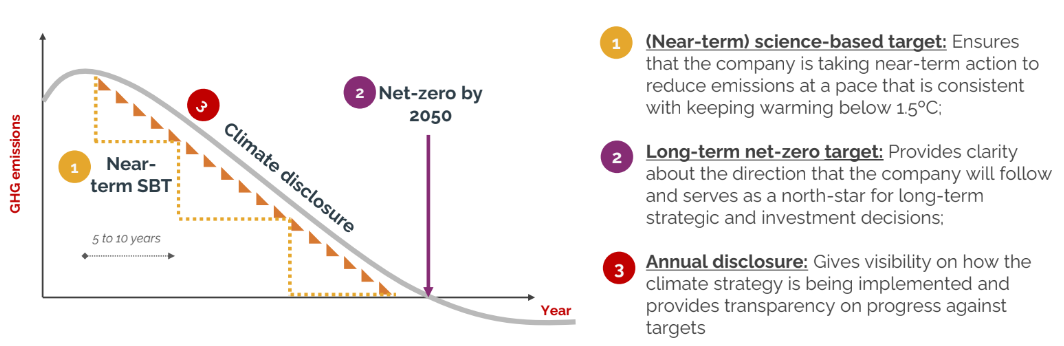
The nature of the targets a company can set depends on the time horizons considered.
The SBT initiative offers companies the possibility to combine different types of targets and levels of ambition, depending on the scope of emissions considered.
These methodological possibilities are summarized in the diagram below.
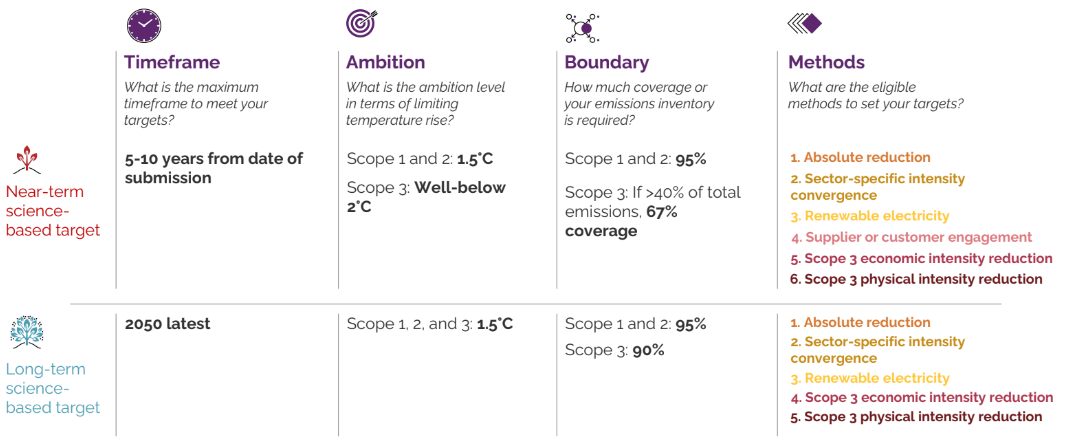
In terms of types of targets, we can therefore distinguish:
- absolute reduction (tCO2eq) targets for emissions: the annual linear reduction must be at least 4.2% for a 1.5°C target or 2.5% for a well-below 2°C target. These are absolute contraction targets, in other words the percentages of reduction are identical for all companies.
For scopes 1 and 2, targets must be aligned with a 1.5°C trajectory, which translates to:
- If the reference year (RY) is 2020 or earlier: a reduction of at least 4.2% per year
- If the RY is after 2020: a reduction of at least 42% by 2030 +/- 4.2%/year
Let's take a few examples:
- RY = 2020 and target year (TY) 2025: the reduction must then be 4.2%/year or 21% by 2025
- RY = 2022 and TY = 2027: the reduction must then be 42+(2027-2030)*4.2 = 29.4% by 2027 or 5.9%/year
- RY = 2022 and TY = 2032: the reduction must then be 42+(2032-2030)*4.2 = 50.4% by 2032 or 5%/year
For scope 3, targets must be aligned at least with a well-below 2°C trajectory, which translates to:
- If the RY is 2020 or earlier: a reduction of at least 2.5% per year
- If the RY is after 2020: a reduction of at least 25% by 2030 +/- 2.5%/year
- carbon intensity reduction targets (tCO2eq/unit) physical: these can be contraction targets or sectoral convergence of the carbon intensity of a product (for example, the carbon intensity of a tonne of steel, a kWh of electricity, etc.).
- economic intensity reduction targets economic: this must be an annual reduction of at least 7% per year. This is a target for reducing economic intensity, meaning the percentage decrease is the same for all companies.
- renewable energy sourcing targets (for scope 2), with a target of at least 80% by 2025, and 100% by 2030.
- and finally, supplier or customer engagement targets: this involves determining a minimum percentage of suppliers who have themselves committed to SBT by a given time horizon.
Some flexibility is thus granted to companies, particularly in terms of scope 3 decarbonization targets: the SBTi has indeed acknowledged the difficulties of decarbonizing companies' value chains, and therefore tolerates that part of the emissions (less than a third of the total scope 3) are not subject to reduction targets.
Similarly, the so-called supplier engagement or physical or economic intensity reduction methodologies aim to enable companies to commit without constraining themselves to absolute value reductions, and to mobilize all stakeholders in reducing emissions.
These different types of targets can be combined on emission categories and items, provided that 95% of scopes 1 and 2 and more than ⅔ of scope 3 emissions are covered by valid SBT targets.
For example, consider a company whose 60% of scope 3 emissions come from inputs, 20% from freight, and 20% from other emission items (travel, immobilization, etc.).
This company can commit to having 50% of its transporters committed to SBT by 2030 and to a reduction in the economic intensity of its inputs of -52% by 2030 compared to the reference year 2022 (equivalent to an annual contraction of 7%).
Such targets cover more than ⅔ of scope 3 and therefore meet the criteria expected by the SBTi.
{{newsletter-blog-3}}
What are the advantages and risks of committing to SBT?
Companies participating in the SBT initiative benefit from several advantages.
First of all, they can improve their reputation and brand image by demonstrating their commitment to environmental sustainability: having emission reduction targets validated by the SBT initiative is very strong evidence to all stakeholders of the seriousness and ambition of a company's low-carbon strategy.
The financial benefits (direct and indirect) associated with reducing emissions are numerous: reduced operational and energy consumption costs, innovation stimulation, better resilience and climate risk management, and finally the opportunity to differentiate from competitors by demonstrating a commitment to sustainability.
It should be noted that the SBT initiative only focuses on setting targets.
In particular, it is not expected (from the SBTi's point of view) that companies setting SBT targets publish an action plan or climate strategy showing how they plan to achieve these targets.
However, it is strongly recommended to engage in strategic thinking parallel to the target-setting stage on the feasibility and conditions for achieving the targets (necessary reduction actions, business model changes to be implemented, suppliers to engage, product eco-design steps to be carried out, etc.).
Resources and guides are indeed provided by the SBT initiative to help companies engage in the process and develop effective action plans.
The only obligation for a company (beyond meeting the criteria for setting targets) is to publish its emissions annually. Companies must therefore set up monitoring and reporting systems to measure their progress and ensure they are on track to meet their targets.
As the SBT initiative is a voluntary framework for companies to commit, there is therefore no penalty or direct financial risk in case of failure to meet the set decarbonization targets.
At most, companies will then be invited, in case of a deviation in actual emissions (compared to the set targets), to set new targets.
However, there may be a reputational risk in case of non-compliance with the set targets, related to the fact of having to publicly assume that the decarbonization targets have not been met.
This is why upstream strategic reflections on defining an action plan commensurate with the set targets are crucial.
How does it work in practice?
Companies wishing to set targets validated by the SBTi must follow a four-step process:
- First, formally commit by sending a letter of intent to the SBTi
- Once its carbon footprint has been completed, choose the reference year and develop targets and objectives that meet the criteria expected by the SBTi
- Submit your goals to the SBTi initiative for official validation
- Publicly communicate the commitment taken to the company's stakeholders
It is important to note that the SBTi is not only for large companies
Small and medium-sized enterprises (companies with fewer than 500 employees) can also participate, through a largely simplified process: these companies only need to complete a commitment form
You can find all the information you need to set SBTi-validated targets and follow the steps one by one on the SBTi's website
It is thus possible to follow the engaged companies on the SBTi website, and to see the type of decarbonization commitment, among the range of possible decarbonization targets that are offered
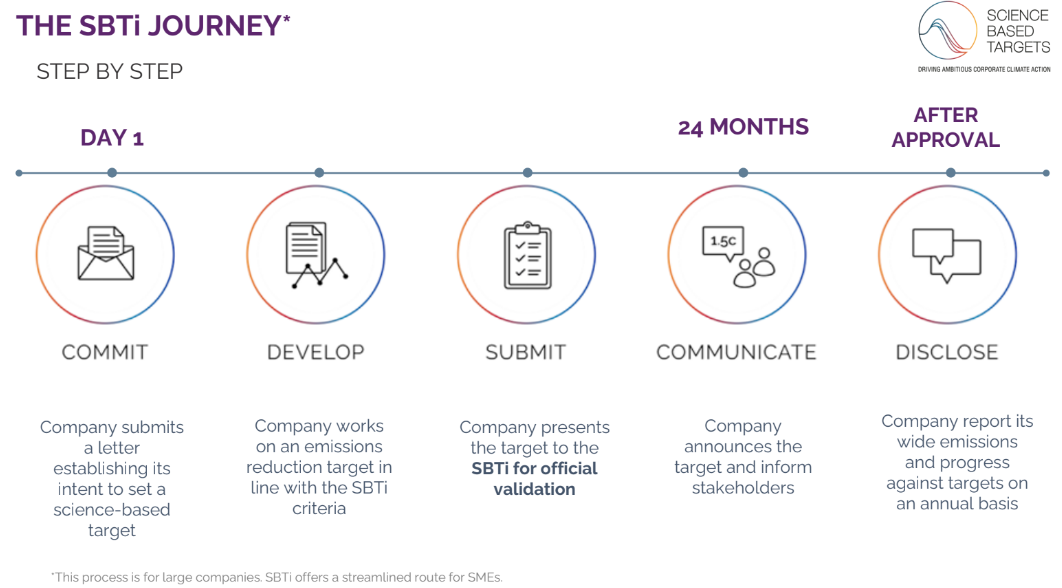
If the company wishes to publicly communicate that the targets have been validated by the SBT, then it must formally submit its targets to the SBTi for official validation
But a company that simply wants to set decarbonization targets (without official validation from the SBTi) can certainly base itself on the SBTi framework
Conclusion
Setting decarbonization targets is a mandatory step in any corporate climate strategy
The SBTi is thus a welcome initiative, which offers a shared and recognized framework for voluntary companies wishing to contribute sincerely and rigorously to the decarbonization of our societies
It has thus established itself over the years as an international reference methodological framework, as evidenced by the growing number of companies committing and submitting such targets
Many other methodological frameworks such as the Net Zero Initiative (NZI) led by Carbone 4 or the ACT methodology led by CDP and ADEME in fact largely rely on the SBTi to structure the step of defining reduction targets
The SBTi offers certain flexibility to companies in terms of target-setting possibilities: not all companies are thus obliged to set short-term absolute reduction targets, but can combine reduction targets in terms of economic or physical intensity, percentage of suppliers themselves engaged in SBT, renewable energy supply, etc
This flexibility has the advantage of facilitating the achievability of the targets set, and thus motivating more companies to set decarbonization targets
However, there are several disadvantages induced by this permissiveness and methodological simplicity:
- if we consolidate all the SBT targets set by companies and if we assume that these targets are achieved, it is not certain that the global carbon budgets will be respected, in other words that climate warming will be limited to the desired level (well below 2°C)
- the decarbonization targets proposed by the SBTi do not adapt sufficiently to the specificities of each company, and in particular they are unsuited to companies contributing to the decarbonization of our societies and set to grow in the context of the ecological transition
Nevertheless, the SBTi has so far established itself as the reference framework, and as many companies as possible are invited to set ambitious decarbonization targets, and thus contribute to the fight against climate change
Decarbonization Mission
Don't miss the latest climate news and stay ahead of regulatory changes




.jpg)

Les commentaires