


The B Corp certification is significantly evolving in 2025 with the introduction of a new framework that fundamentally transforms the approach to assessing companies. This guide presents in detail the new requirements and the certification process.
What is the B Corp certification?
The B Corp certification is one of the most demanding recognitions in terms of corporate social responsibility. Awarded by the independent organization B Lab, it distinguishes companies that meet high social and environmental standards, making transparency and legal responsibility fundamental principles of their governance.
Beyond a simple label, B Corp represents a global movement of committed companies that use business as a positive force to address current societal and environmental challenges. To date, more than 7,000 companies are certified B Corp in 86 countries, covering 158 different sectors.
Did you know that France has more than 250 certified B Corp companies? Among them are major players like Danone, Nature & Découvertes, Faguo and also Sami.
The new B Corp framework
B Lab has undertaken a complete overhaul of its certification system with the introduction of a new framework applicable from 2025. These are applicable since January 1, 2026.
This fundamental transformation abandons the previous model based on the accumulation of points (minimum 80/200) to adopt an approach based on specific requirements structured around impact themes.
Objectives of the new framework
The new framework aims to:
- Standardize the practices of certified companies
- Strengthen the credibility and consistency of the movement
- Adapt the requirements to the specific context of each company
- Promote continuous improvement of practices
The new evaluation structure
The certification process now relies on two main categories of requirements:
- The basic requirements (fundamental prerequisites)
- The impact theme requirements (adaptation according to the company's profile)
The basic requirements (FR)
To start the certification process, any company must first meet three fundamental requirements:
- Meet the eligibility criteria
- Be legally constituted and active for at least 12 months
- Comply with local and national regulations
- Not be significantly involved in sectors incompatible with B Lab's theory of change
- Adopt stakeholder-oriented governance
- Integrate the B Corp legal requirement into the company's bylaws
- Sign the B Corp Interdependence Declaration
- Conduct a risk assessment
- Establish a risk profile via B Lab's analysis tool
- Determine the additional due diligence requirements
The seven impact themes
After validation of the basic requirements, the company must meet the specific requirements distributed in seven impact themes:
- Mission and Stakeholder Governance (MSG)
- Definition of a mission integrating social and environmental objectives
- Implementation of inclusive governance considering all stakeholders
- Climate Action (CA)
- Measurement and reduction of greenhouse gas emissions
- Alignment with current scientific knowledge
- Justice, Equity, Diversity and Inclusion (JEDI)
- Creation of inclusive work environments
- Contribution to equitable communities
- Public Affairs and Collective Action (PACA)
- Ethical engagement in public affairs
- Positive contribution to the local economy
- Fair Work (FW)
- Quality of jobs offered
- Positive and fulfilling company culture
- Human Rights (HR)
- Respect for human dignity
- Protection of rights throughout the value chain
- Environmental Management and Circularity (EMC)
- Comprehensive environmental management system
- Contribution to the circular economy
Important: The exact number of requirements to meet varies according to the size, sector, and industry of the company, ranging from 20 to 124 requirements. The geographical location also determines eligibility for the equity mechanism, a device that adapts requirements to local contexts.
Find the list of BCorp requirements here.
Focus on the climate action theme and the carbon footprint
The "Climate Action" theme requires companies to measure their greenhouse gas emissions and define and implement climate transition plans with emission reduction targets.
However, some of these requirements are conditioned by the size of the company or its sector of activity.
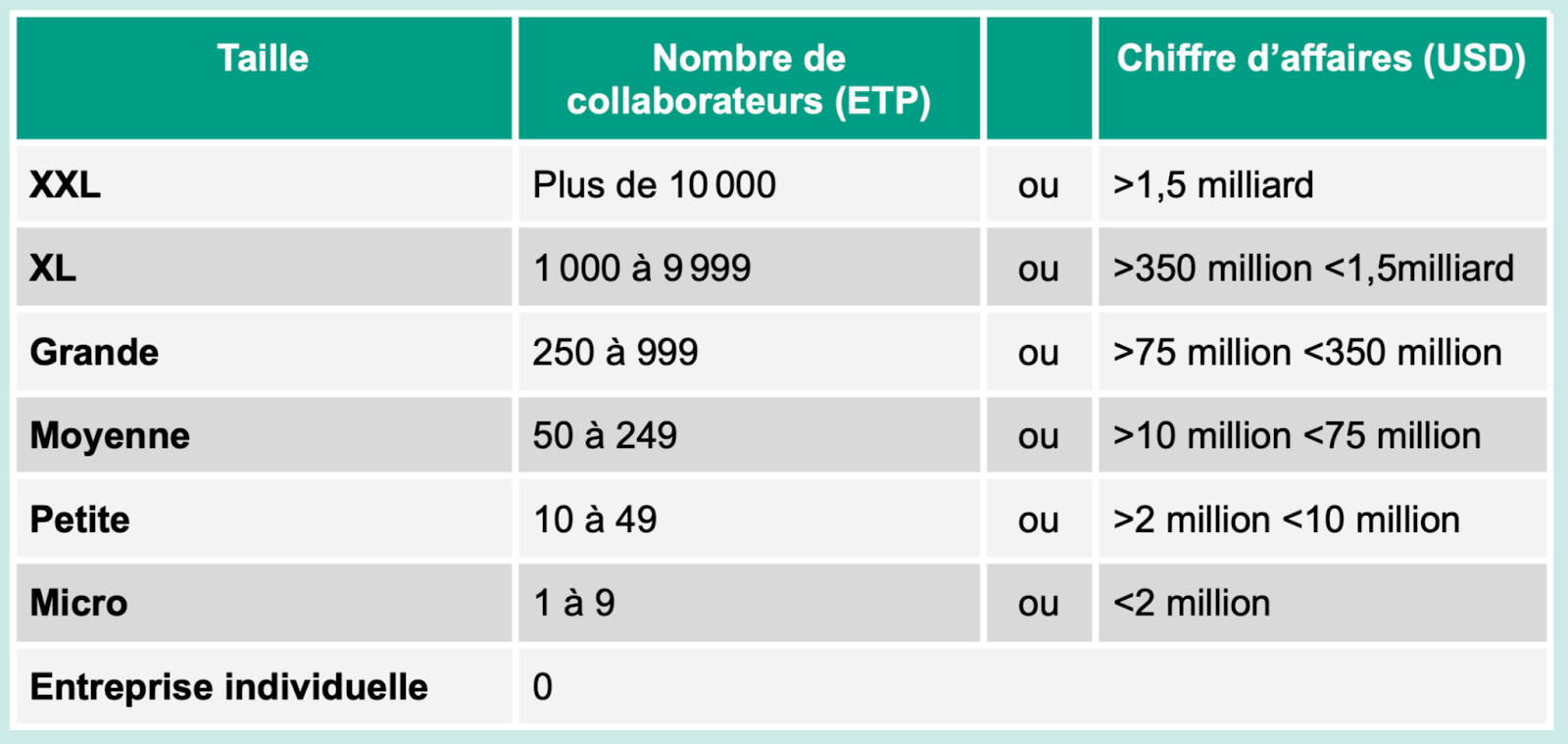
Here is the categorization of companies first. It depends on the number of their employees or their turnover. It is the lowest of the two that is taken into account.
B Corp and the carbon footprint
- Mandatory carbon footprint
The realization of an annual carbon footprint for B Corp certification is mandatory for all companies with more than 250 employees or with a turnover exceeding 75 million dollars, all sectors combined. In other words, for all companies whose size is Large, XL or XXL (cf table above).
For these companies, the carbon footprint must:
- be measured every year
- include emissions from Scopes 1, 2, and 3
- be in accordance with the GHG Protocol or ISO 14064 methodology
- be published in one of the following documents: the annual report, the annual sustainable development report or another public report available on the company's website
- Verification of the carbon footprint by an independent third-party organization
The realization of an annual carbon footprint is accompanied by an obligation to verify this carbon footprint by an independent third-party organization for companies belonging to the following sectors:
- Wholesale/distribution
- Services with a low environmental footprint
- Services with a significant environmental footprint
- Agriculture/Agricultural Producers
- Manufacturing industries
The verification must:
- be carried out every year
- ensure that emissions from Scopes 1 and 2 and emissions from the relevant categories of Scope 3 are covered
- be carried out by an independent third-party organization accredited by a National Accreditation Body member of the International Accreditation Forum (IAF)
The definition of climate transition plans
Beyond measuring the carbon footprint, B Corp now requires companies to define a trajectory for reducing their emissions. The content and ambition of these transition plans differ according to the size of the company.
- For companies with more than 250 employees or with more than 75 million dollars in revenue
The company must have objectives aligned with scientific knowledge and validated by the Science Based Targets initiative (SBTi) or verified by an independent third-party organization.
The objectives must be:
- short-term emission reduction targets
- zero net emissions targets, aligned with the 1.5°C trajectory.
The climate transition plan of these large companies must in particular:
- include measures to mitigate emissions
- describe how the company plans to work with its stakeholders
- include a plan to mobilize resources to achieve the objectives set by the company
- include the investment allocated to the implementation of the transition plan during the last fiscal year
- detail how its business model contributes or will contribute to achieving the objectives
- For companies with fewer than 250 employees or with less than 75 million dollars in revenue
The company must have a public climate action plan. The latter must:
- commit to supporting the ambition to limit global warming to 1.5°C
- include specific, measurable, and achievable objectives in terms of performance and impact
- specify the resources allocated by the company to the implementation of this plan
- describe how the company works with its stakeholders
This action plan must be updated every 3 years.
Implementation and monitoring of the action plan
Companies must then be able to implement and monitor progress on their climate action plan.
This includes in particular:
- setting climate objectives in the incentive remuneration system of the management team
- use of advocacy
- assessment of the effectiveness of the action plan
- publication of the progress of the action plan
Again, the requirements differ depending on the size of the company and sometimes its sector of activity.
You will find all the requirements related to this climate action theme in the complete document of the new B Corp standards.
{{newsletter-blog-3}}
The B Corp certification process according to the new framework
The B Corp certification process follows a precise and methodical sequence:
1. Preliminary assessment
- Registration on the B Impact platform
- Determination of the company's profile (size, sector, location)
- Identification of applicable requirements
2. Compliance with basic requirements
- Verification of eligibility criteria
- Adaptation of legal statutes
- Conducting the risk assessment
3. Response to impact theme requirements
- Self-assessment on each of the seven themes
- Collection of data and documentary evidence
- Implementation of required practices according to the company's profile
4. Verification by B Lab
- Submission of the complete file
- In-depth analysis by B Lab teams
- Interviews and additional checks
5. Certification and continuous improvement
- Signing of the Interdependence Declaration
- Commitment to improvement objectives (years 3 and 5)
- Recertification every three years
Good to know: The average duration of the entire process is 6 to 12 months, depending on the complexity of the company.
The continuous improvement approach
A fundamental characteristic of the new framework is the integration of a continuous improvement logic over a five-year cycle:
- Year 0: Initial requirements to obtain certification
- Year 3: Mandatory intermediate requirements
- Year 5: Advanced requirements to be achieved
This progression ensures that B Corp companies remain at the forefront of responsible practices and commit to a continuous improvement approach.
The strategic advantages of B Corp certification
B Corp certification brings many benefits to companies that commit to this demanding approach:
Strategic advantages
- Competitive differentiation: join the circle of the most committed companies in the world
- Talent attractiveness: 86% of employees say they are more engaged in a mission-driven company
- International network: join a community of more than 7,000 companies sharing the same values
- Regulatory anticipation: prepare for legislative changes (CSRD, duty of vigilance)
Operational benefits
- Process optimization: identify inefficiencies in the value chain
- Cost reduction: reduce energy and resource consumption
- Risk management: anticipate environmental and social risks
- Responsible innovation: stimulate sustainable innovation within teams
Commercial benefits
- Customer trust: 78% of consumers have more trust in certified companies
- Market access: meet ESG criteria in tenders
- Investor appeal: 70% of investors consider ESG criteria in their decisions
FAQ: B Corp certification according to the new framework
What is the cost of a B Corp certification?
Certification fees depend on the company's annual turnover:
- Less than €1M: around €1,000
- From €1M to €5M: around €2,500
- From €5M to €50M: around €5,000
- More than €50M: up to €50,000 for very large groups
Internal preparation costs and possibly external support costs are added to this.
How long does the certification process take?
The complete process usually takes between 6 and 12 months, including the initial self-assessment, implementation of necessary actions, statutory changes, and verification by B Lab.
What is the difference between B Corp and a mission-driven company?
The mission-driven company is a French legal status introduced by the PACTE law in 2019, while B Corp is a private international certification. Both are complementary: becoming a mission-driven company facilitates obtaining B Corp certification by already meeting the statutory modification requirement.
Do companies already certified need to immediately comply with the new framework?
No, B Lab provides a transition period allowing already certified companies to gradually adapt to the new framework during their next recertification cycle.
How do I know which requirements apply to my company?
The B Impact platform automatically determines the applicable requirements based on your company's profile (size, sector, location). A pre-configuration tool is available to help you identify these requirements even before starting the process.
Does the equity mechanism apply to all companies?
No, this mechanism for adapting requirements only applies to companies located in certain countries, according to a classification established by B Lab. It aims to take into account differences in socio-economic and regulatory contexts.
Conclusion
The new B Corp 2025 framework represents both a challenge and an opportunity for committed companies. This major evolution, which replaces the point-based approach with specific requirements, aims to standardize practices while taking into account the particularities of each company. The certification process becomes more rigorous but also more adapted to current challenges, particularly in terms of climate with the central requirement of a carbon footprint and reduction trajectory.
By engaging in this demanding approach, companies do not just obtain a prestigious label, they join a global movement that aims to transform the economy into a more inclusive, equitable, and regenerative system.
{{newsletter-blog-3}}
Decarbonization Mission
Don't miss the latest climate news and stay ahead of regulatory changes


Start your labeling process with Sami
Use the Sami software to track your various CSR and climate indicators




Les commentaires