The CSRD (Corporate Sustainability Reporting Directive) entered into force on 5 January 2023 and has applied since financial year 2024 to the first companies in scope. This European directive, which replaces the former NFRD (Non-Financial Reporting Directive), requires large companies to publish an annual sustainability report.
Everything you need to know about the CSRD is here!
The CSRD requires companies to adapt their sustainability reporting to comply with standardised European standards, including the ESRS.
After a first version in 2023, the European Commission adopted the final delegated act revising the ESRS on 3 July 2026, published in the Official Journal of the EU on 21 September 2026 (Delegated Regulation (EU) 2026/1563).
In practical terms, what are the ESRS? What are the main changes in the revised ESRS? How will this affect your business? Here's everything you need to know.
What are the ESRS?
The new European reporting standards developed by EFRAG
To complement the new CSRD, EFRAG (the European Financial Reporting Advisory Group) was appointed as technical adviser to the European Commission. Its role was to develop detailed reporting standards: the ESRS (European Sustainability Reporting Standards). EFRAG works closely with the European Commission to develop harmonised ESG reporting templates across the European Union.
In practical terms, the ESRS are the European reporting standards, i.e. the European environmental, social and governance (ESG) reporting criteria. This set of new standards aims to improve the sustainability reporting of companies at the European level by promoting greater transparency, harmonisation and standardisation of companies' non-financial disclosures. This will facilitate the comparison of extra-financial reports across different European companies.
All companies within the scope of the CSRD must therefore comply with the European sustainability reporting standards set out in the ESRS. The first version of the ESRS was adopted by the European Commission on 31 July 2023 (Delegated Regulation (EU) 2023/2772).
However, in 2024, the President of the Commission announced her objective to reduce the buratic complexity and administrative burden on in-scope companies.
This took shape in February 2025 with the Commission’s publication of its proposed Omnibus directive, finally adopted in 2026 (Directive (EU) 2026/470). It was in this context that the Commission mandated EFRAG to work on a major simplification of the ESRS. The simplified ESRS were published in the Official Journal on 21 September 2026. They enter into force on 10 November 2026 and are mandatory for financial years beginning on or after 1 January 2027.
The ESRS are based on the three pillars of CSR: Environmental, Social and Governance
To comply with the CSRD, companies must collect and disclose information through their reporting about three things: their environmental impacts, their social impacts and their governance practices (ESG criteria)
It therefore comes as no surprise that the ESRS standards developed by EFRAG are built on these three essential pillars.
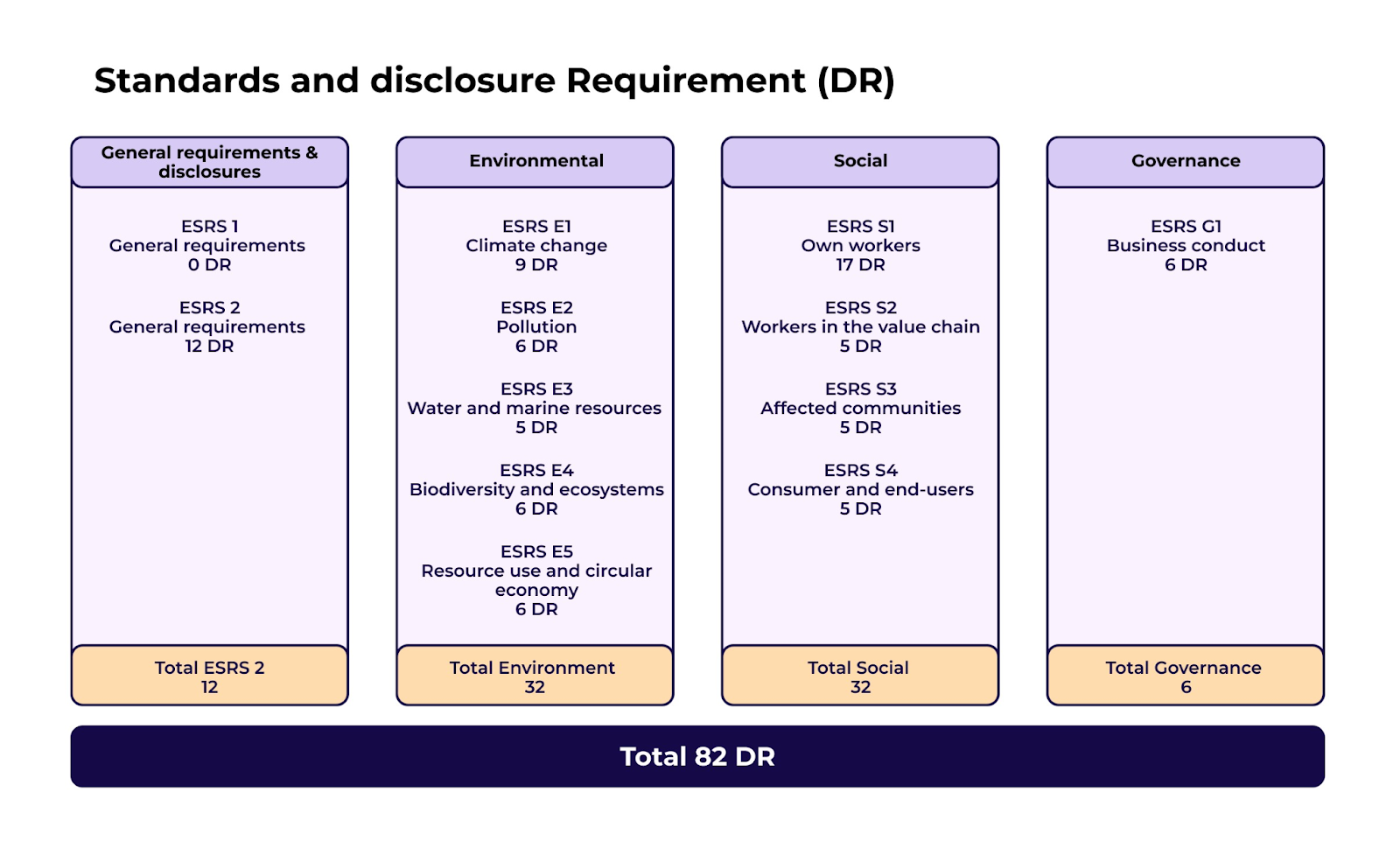
The 12 topics covered by the ESRS are as follows:
2 general criteria:
ESRS 1 General requirements
ESRS 2 General disclosures
5 environmental criteria:
ESRS E1 Climate change
ESRS E2 Pollution
ESRS E3 Water and marine resources
ESRS E4 Biodiversity and ecosystems
ESRS E5 Resource use and circular economy
4 social criteria:
ESRS S1 Own workforce
ESRS S2 Workers in the value chain
ESRS S3 Affected communities
ESRS S4 Consumers and end-users
1 governance criterion:
ESRS G1 Business conduct
Find the details of the 12 ESRS in Annex 1 of the European Commission’s delegated act here.
What are the main changes in the revised ESRS?
On 3 July 2026, the European Commission adopted the delegated act revising the ESRS, published in the Official Journal on 21 September 2026.
Here are the main changes:
- A 70% reduction in the number of datapoints
Around 60% of mandatory data points have been removed (61% according to EFRAG’s technical advice), along with 100% of voluntary ones.
- Double materiality
The double materiality assessment is truly at the heart of CSRD compliance, because its results determine the data expected in the sustainability report.
As a reminder, double materiality analysis combines two types of materiality: financial materiality and impact (or non-financial) materiality.
The principle of double materiality is maintained in this new version of the ESRS, but with one major change. To simplify how the analysis is carried out, a more pragmatic approach is now permitted, known as the “top-down” approach. Companies can start from their business model and reach a conclusion at topic level, rather than assessing the materiality of each impact, risk or opportunity individually, avoiding a considerable amount of unnecessary work. They can combine this approach with a “bottom-up” analysis for certain topics.
The new text also clarifies that companies must not publish information that is not material, which was not stated as explicitly in the previous version.
- The ‘fair presentation’ principle
The revised ESRS clarify the principle of fair presentation.
The aim is simple: to ensure that fair presentation applies to the sustainability statement as a whole, not to each individual data point.
This should allow companies to focus their report on essential information, the information that best reflects their activities, impacts, risks and opportunities, and so avoid information overload.
It is no longer about mechanically filling in every data point, but about ensuring that the report as a whole gives a fair picture of the material issues. The auditor of the sustainability report will therefore have to assess this fair presentation, rather than check that every box has been ticked. The simplification of the double materiality analysis follows the same philosophy.
- ‘Undue cost or effort’
The revised ESRS also extend the “undue cost or effort” principle, which already existed in the 2023 version, notably for value chain information. In practice, it allows companies not to publish certain information if obtaining it would involve disproportionate cost or effort.
This applies to:
- identifying material impacts, risks or opportunities during the double materiality analysis
- determining the scope of the upstream and downstream value chain
- including information on the upstream and downstream value chain
- preparing information on metrics
- reporting on current and anticipated financial effects.
This is an important justification for companies, particularly in view of the sustainability report audit.
- Omission of information
The text introduces new grounds on which companies may omit information, notably where disclosure could seriously harm the company’s commercial position, where the information relates to intellectual capital or technological information, or where it is classified information.
Companies must nonetheless indicate each time they omit information that they are relying on this exemption.
- More transitional periods
New phase-in arrangements have been introduced in the simplified ESRS. This is notably the case for disclosing anticipated financial effects. Wave 1 companies may omit them for financial years before 2028 (2030 for quantitative information), and other companies for their first two reporting years (four for quantitative information).
How the ESRS work
General disclosures
Environmental disclosures
Social disclosures
Governance disclosures
What does a company have to report on?
Under the revised ESRS:
- Only the general disclosures remain mandatory in all cases.
- For the other ESRS, the double materiality analysis determines which topics the company must cover and publish in its report. It is therefore up to the company to specify what it considers appropriate to publish following its materiality analysis. Compliance with the ESRS framework for carrying out the double materiality analysis is one of the points that is audited.
Read our expertise: How to succeed in your double materality assessment
- For ESRS E1 “Climate change”: if the company concludes that climate is not material, it must provide a detailed explanation of that conclusion. This must include a forward-looking analysis of the conditions that could lead it to consider climate material in the future. For this ESRS, the burden of proof is said to be reversed! Many believe it will be difficult not to report on climate, on the grounds that there are few, if any, human activities that do not emit greenhouse gases.
Good to know: where climate is material, ESRS E1 (disclosure requirement E1-8) requires companies to publish their full [carbon footprint] (Scopes 1, 2 and 3). The default reporting boundary remains financial control, but the GHG Protocol’s “operational control” and “equity share” approaches are now permitted.
- Each ESRS contains DRs (disclosure requirements). These are the specific pieces of information companies may have to publish under the CSRD. They relate to important aspects of the company, such as its financial, environmental, social and governance performance. To publish this information, companies have to collect and present data points.
Are the ESRS compatible with the ISSB’s international standards?
Not automatically. The revised ESRS aim for better interoperability with the standards of the ISSB (International Sustainability Standards Board), but the Commission has ruled out any route to simultaneous compliance. Companies targeting both frameworks need to identify the additional information required by the ISSB. They should also be cautious before using certain ESRS-specific reliefs, which are more permissive than those of the ISSB. EFRAG and the ISSB have published interoperability guidance, and an update for the revised ESRS is expected.
Conclusion
The simplification of the ESRS, now enacted by Delegated Regulation (EU) 2026/1563, will allow companies to build more appropriate reporting and focus on the most significant aspects of their CSR impacts, risks and opportunities, while maintaining a high standard for the information expected. Users, for their part, will benefit from more readable and accessible sustainability reports.
Companies now need to familiarise themselves with these new reporting standards so they can adapt their data collection as quickly as possible and prepare their reports. The new ESRS will apply to reports published in 2028 covering financial year 2027. For financial year 2026, Wave 1 companies have three options: apply the current ESRS, adopt the revised ESRS early, or apply the current ESRS while using certain reliefs from the revised ESRS. They must clearly state which version they have applied.
{{newsletter-blog-3}
FAQ
What does ESRS stand for?
ESRS stands for European Sustainability Reporting Standards. They are the European sustainability reporting standards, developed by EFRAG, that companies subject to the CSRD must follow to structure their sustainability report.
What are the 12 topics covered by the ESRS?
The ESRS comprise 2 cross-cutting standards (ESRS 1 “General requirements” and ESRS 2 “General disclosures”), 5 environmental standards (E1 Climate change, E2 Pollution, E3 Water and marine resources, E4 Biodiversity and ecosystems, E5 Resource use and circular economy), 4 social standards (S1 to S4) and 1 governance standard (G1 Business conduct).
What are the main changes in the revised ESRS adopted on 3 July 2026?
The revision removes around 60% of mandatory data points and 100% of voluntary ones, simplifies the double materiality analysis through a “top-down” approach, and clarifies two principles: “fair presentation” (assessing the report as a whole rather than data point by data point) and “undue cost or effort” (justifying certain omissions where cost or effort would be disproportionate).
Are all ESRS topics mandatory for a company?
No. Only the general disclosures (ESRS 2) are mandatory for all companies subject to the CSRD. For the other topics, the double materiality analysis determines which ones must be published, except for ESRS E1 (climate), where the burden of proof is reversed: the company must provide a detailed explanation, including a forward-looking analysis, if it concludes that climate is not material.
Are the ESRS compatible with the ISSB’s international standards?
Not automatically. The ESRS aim for interoperability with the ISSB, but the Commission has not created a dual-compliance route. EFRAG-ISSB interoperability guidance helps identify the additional information to be published.


Our consultants support you with your double materiality assessment, gap analysis, reporting follow-up and data export in the required format.

On the same topic
More articles to explore, written with just as much passion