


In a rapidly changing economic world, Corporate Social Responsibility (CSR) is no longer an option but a strategic necessity. For example, 62% of M&A decision-makers in France have already abandoned a potential acquisition because of ESG-related issues (Deloitte study, July 2024). Against this growing demand for transparency and commitment, EcoVadis has established itself as the global standard for corporate CSR assessments.
With more than 150,000 companies assessed across 175 countries, EcoVadis has become an essential benchmark for measuring, comparing and improving CSR practices. Its methodology, recognised by major international groups, provides an objective and comparable score and is gradually transforming global supply chains.
However, many companies feel unprepared for the EcoVadis process: which documents should be prepared? How should the criteria be interpreted? How can CSR initiatives be presented effectively? How can the assessment be turned into a genuine competitive advantage?
Whether you are an SME facing this assessment for the first time at the request of a major customer, or a large company seeking to improve its score in order to access new markets, this guide will take you through the process step by step. From methodological fundamentals and practical guidance on preparing your submission to continuous-improvement strategies, it covers the essential points for understanding and succeeding in your EcoVadis assessment.
1. What is EcoVadis?
Founded in 2007, EcoVadis has become a global reference for assessing Corporate Social Responsibility performance. It was created from the conviction that sustainable practices can positively transform global supply chains, and the Franco-American company now operates in more than 175 countries.
EcoVadis has a clear mission: to improve companies’ environmental and social practices by providing reliable CSR assessments and collaborative tools for global supply chains. Its vision is of a world in which business decisions systematically incorporate sustainability, thereby creating a more responsible and resilient economy.
The EcoVadis ecosystem is built around three core pillars. Its online platform provides centralised access to assessments and improvement tools. Its methodology, aligned with international standards such as ISO 26000, GRI and the UN Global Compact, reviews 21 criteria across four themes: environment, labour and human rights, ethics, and sustainable procurement. Its services include assessment, sector benchmarking and support for continuous improvement.
EcoVadis offers several subscription packages tailored to companies’ specific needs. Suppliers can access a basic assessment, while buyers can use more comprehensive solutions to manage their supplier portfolios. Premium services include personalised support, detailed sector analysis and CSR risk-management tools.
2. The EcoVadis assessment methodology
2.1 What is the EcoVadis assessment?
When a company undergoes an EcoVadis assessment, its CSR approach is reviewed and scored by EcoVadis. The assessment takes the form of a questionnaire completed by the company being assessed.
The aim is to give companies a clear view of their impact, help them compare themselves with other businesses in the same sector, and encourage them to continuously improve their CSR approach and environmental impact.
Companies may choose to undergo the assessment voluntarily, although it is very common for them to do so at the request of stakeholders such as customers or investors.
2.2 Assessment themes and criteria
In practice, the assessment is a questionnaire covering the following four CSR themes:
- Environment: resource management, CO₂ emissions, waste, water, biodiversity, pollution, etc.
- Labour & Human Rights: working conditions, diversity, health and safety of employees etc.
- Business Ethics: corruption, responsible business practices etc.
- Sustainable Procurement: supplier management, etc.
The questions cover all 21 sustainability criteria below:
For the environmental pillar, it is therefore essential to begin by calculating the company’s carbon footprint so that it can report both its greenhouse gas emissions and its reduction trajectory, together with the action plan that has been put in place. EcoVadis assesses both policies and actions.
{{newsletter-blog-3}}
It may be useful to appoint an internal lead for each of the four themes, responsible for answering the questions relating to that area.
Although every company is assessed across the four themes above, the weighting of each theme in the final score varies according to the company’s sector, because the assessment is tailored to its business activity.
For each of the four themes, EcoVadis measures the quality of the company’s CSR management system through three management pillars: Policies, Actions and Results.
These three pillars are divided into seven management indicators: Policies (POLI), Endorsements (ENDO), Measures (MESU), Certifications (CERT), Coverage (COVE), Reporting (REPO) and 360° Watch Findings (360).
Depending on the company’s sector, size and country, certain sub-themes may be excluded and not assessed.
An explanatory video on the EcoVadis website provides further information about the content and structure of the questionnaire you will receive.
2.3 What are the EcoVadis scoring levels and medals?
As we have seen, the EcoVadis framework does not base its rating solely on whether or not a company has achieved a particular outcome. It also assesses all the policies and actions the company has put in place to become more sustainable.
The assessment results in an overall score out of 100.
Below is the scoring scale applied to each theme:
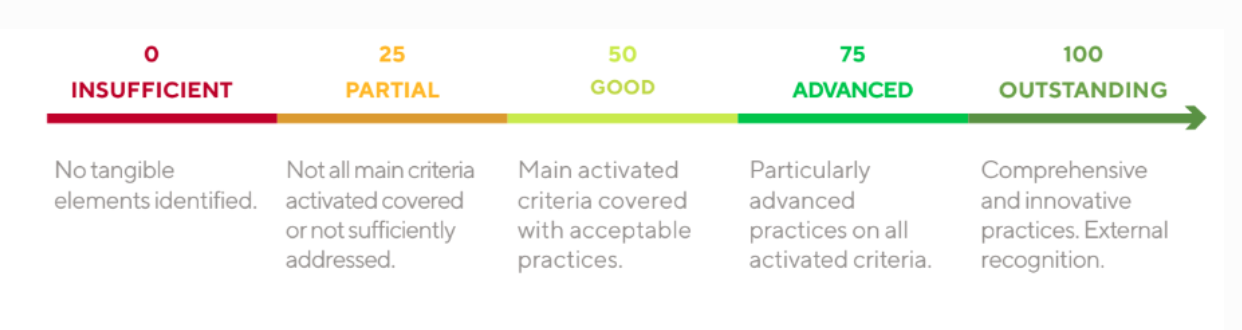
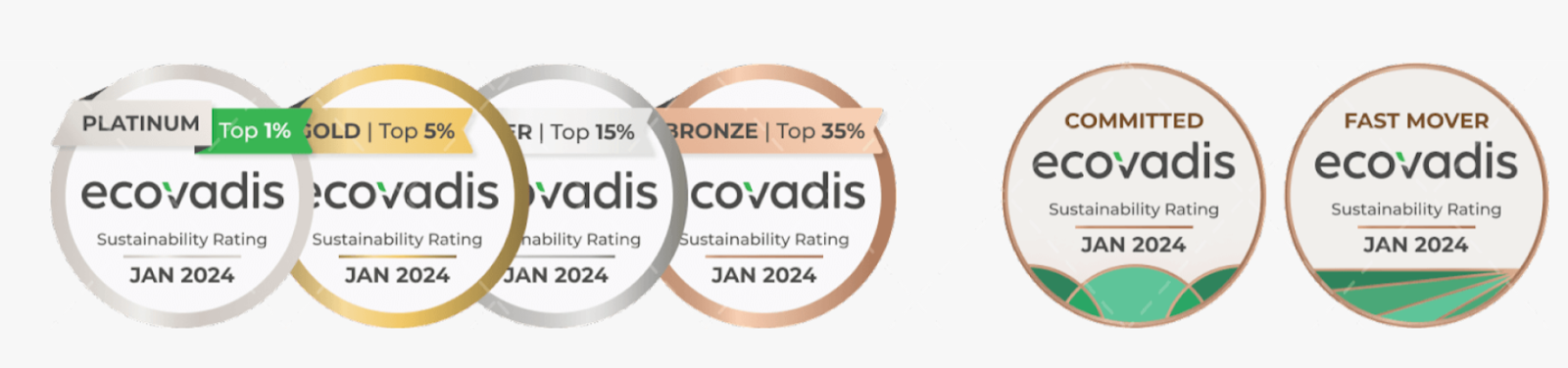
Following the assessment, a medal - Bronze, Silver, Gold or Platinum - may be awarded to the highest-rated companies. Whether a company receives a medal depends on several factors, including:
- Its score compared with those of other assessed companies: a medal or badge recognises achievement relative to other companies assessed in the EcoVadis database.
- Whether it has achieved a minimum score of 30 in each of the four themes.
3. How to get support for your EcoVadis assessment or to improve your EcoVadis score?
3.1 Dedicated support is key
Navigating a first EcoVadis assessment isn't always straightforward, and neither is fully understanding why your company received a given score, or more importantly, how to improve it.
That's why being supported by ESG experts who know the EcoVadis methodology inside out, and who can guide you step by step, can be essential.
And that's exactly what we can offer, as Sami is a partner of the international SGS group, present in 115 countries. Since 2025, SGS has been an official EcoVadis consulting partner (Accredited Core Consulting Partner).
SGS is also an official EcoVadis partner for on-site audits carried out as part of assessments.
Our ESG Hub also automates the collection and centralizes on a single platform all the ESG indicators required for your EcoVadis assessment.
3.2 Improving your EcoVadis score by having your carbon footprint verified
Having your carbon footprint verified is not mandatory as part of an EcoVadis assessment.
However, verification by an independent third party helps improve your rating, as EcoVadis then considers that the carbon data submitted by the company benefits from the highest level of reliability. This is rewarded with a higher score. It's therefore an effective way to significantly boost your rating on the environmental pillar.
Your carbon footprint verification must be carried out by an Independent Third-Party Body (ITPB), such as SGS, in compliance with the ISO standard for verifying greenhouse gas emissions inventories, ISO 14064-3.
4. Detailed steps of the EcoVadis assessment process
The process consists of three main stages.
- Registration and submission of the questionnaire on the EcoVadis platform
- Register on the platform and provide the main information about your company: its business sector, location and size. Based on this information, EcoVadis provides a guidance document and a CSR assessment tailored to those criteria.
- Complete the questionnaire and upload supporting documents for each question. Formal evidence is central to the EcoVadis assessment: each answer must be supported by a document in order to be taken into account. Answers without supporting evidence will not be scored. Wherever possible, provide the most relevant evidence to avoid being penalised. The question-mark icon for each question helps identify the most appropriate evidence.
- Submit the questionnaire.
- Analysis of the submitted documents by the EcoVadis team
All uploaded documents are automatically added to the EcoVadis platform’s document library. The same supporting document may be used for several questions where relevant.
To be accepted, documents must demonstrate the company’s CSR management system, the policies and actions introduced, and how results are measured.
Documentation requirements vary according to company size. For example, where an SME does not have a formal CSR policy, EcoVadis allows greater flexibility and may accept a future CSR action plan or a letter from management setting out a future commitment.
A maximum of 55 documents may be uploaded. However, quality and relevance matter more than quantity: according to EcoVadis, between 8 and 22 carefully selected documents can be sufficient to achieve a high assessment score.
- Allocation of a score and recommendations for improvement
Once the questionnaire has been submitted, EcoVadis analysts review the answers and award scores for each criterion and theme in accordance with detailed guidelines.
A score from 0 to 100 is awarded for each of the four themes. Results are generally available within six to eight weeks.
The company can compare its score with those of other businesses in the same sector. The report also includes recommendations for improving the score. You can find an example of an EcoVadis scorecard here.
5. Preparing effectively for an EcoVadis Assessment
.1 Checklist of essential documents by pillar
Environment
- Formal environmental policy
- Carbon footprint assessment
- ISO 14001 certification documents (if applicable)
- Energy consumption data
- Proof of waste and recycling management
- Environmental footprint reduction initiatives
Labour and Social Matters
- Human resources policy
- Workplace equality report
- Occupational health and safety documentation
- Evidence of training provided
- Standard employment contracts
- Diversity and inclusion indicators
Business Ethics
- Code of ethical conduct
- Anti-corruption procedures
- Whistleblower policy
- Ethical risk mapping
- Gifts and invitations register
- Contracts with business partners including ethical clauses
Sustainable Procurement
- Supplier charter
- CSR criteria used in supplier selection
- Evidence of supplier audits
- Sustainable procurement development plan
5.2 Recommended Preparation Calendar
6 to 12 Months Before the Assessment
- Launch the preparation project
- Define clear objectives
- Set up the project team
- Hold an initial scoping and awareness meeting
4 Months Before
- Carry out an internal audit
- Systematically collect documents
- Identification of gaps and action plans
- Conduct an initial document review
2 Months Before
- Finalise documents
- Prepare the submission file
- Training of participants
Final Week
- Carry out final check of the documents
- Train the participants
5.3 Common Mistakes to Avoid
Documentation
- Incomplete or outdated documentation
- Lack of concrete evidence
- Inconsistencies between statements
- Actions that cannot be traced or verified
Strategy
- Underestimating the process
- Insufficient preparation
- Poor internal communication
- Treating the project as a purely administrative exercise
The key to success lies in methodical, collaborative and early preparation. The EcoVadis assessment should not be seen as a burden, but as an opportunity to demonstrate the value of the company’s CSR commitments.
6. Strategic benefits of a strong EcoVadis rating
The EcoVadis assessment is demanding, which can discourage many companies. However, it also represents a genuine strategic opportunity.
The main benefits of a strong EcoVadis rating include:
- Meeting stakeholder expectations, including those of customers, investors and suppliers. It is often a company’s business partners that request an EcoVadis assessment.
- Responding effectively to increasing sustainability regulation.
- Improving image and reputation. A highly rated company is seen as environmentally responsible and may attract more customers and investors.
- Increasing attractiveness and competitiveness and accessing new business opportunities. Many companies require suppliers to undergo an EcoVadis asessement, and investors may do the same.
- Improving internal processes. The assessment helps identify areas for improvement and supports the implementation of effective actions. It can also serve as the basis and starting point for a broader CSR strategy.
- Collecting indicators that can also be used for other ESG frameworks, including CSRD, VSME…
{{newsletter-blog-2}}
7. FAQ
How much does an EcoVadis assessment cost?
Prices vary according to the company’s size, measured by number of employees, and its country. Several packages are available:
- Basic: Includes access to a personalised questionnaire, an assessment scorecard and a CSR rating, as well as internal sharing of scorecards. External sharing is not available. This is the least expensive package. For a French company with up to 25 employees, a one-year subscription costs €429; for a company with 26 to 99 employees, it costs €729 per year.
- Premium: Also allows the company to promote its performance externally using EcoVadis medals and badges, assess up to five of its own partners, and share its scorecard externally without restriction. The price is €849 per year for companies with fewer than 26 employees and €1,159 per year for companies with 26 to 99 employees.
- Select: Includes an orientation call, a session with an analyst, a dedicated support team and priority assessment. It is the most expensive package: €2,747 per year for very small companies and €3,319 for small companies with fewer than 100 employees.
All assessment rates and options offered by the different offers are available on this page.
How long does an EcoVadis assessment last?
There is a significant preparation period before the assessment. Preparing may take several months and, in some cases, up to a year.
Once the questionnaire and supporting evidence have been submitted, the assessment process takes an average of six to eight weeks, depending on the size of the company and the complexity of the documentation.
How long is an EcoVadis score valid?
An EcoVadis score is valid for 12 months. After that period, a full reassessment is required to maintain the rating and ensure that the company’s social and environmental responsibility data remain up to date.
How can an assessment result be challenged?
EcoVadis offers a two-stage review process:
- Submit a formal request for review within 30 days of receiving the report.
- Provide additional documentary evidence demonstrating information that was not initially taken into account.
Is EcoVadis recognised internationally?
Yes. EcoVadis is recognised worldwide and is regarded as one of the leading CSR assessment platforms, with more than 150,000 companies assessed across 200 business sectors.
How does the reassessment work?
The reassessment follows the same process as the initial assessment:
- Update the questionnaire
- Collection of new documents
- Undergo a detailed review by EcoVadis analysts
- Receive a new report and score
Is EcoVadis suitable for small businesses?
EcoVadis now offers formats adapted to SMEs and startups, with:
- Shorter questionnaires
- Costs scaled to the size of the company
- Personalised support
- An assessment method proportionate to the company's resources
Advice: Whatever the size of the company, the important point is to demonstrate a genuine commitment to social and environmental responsibility.
Is the EcoVadis assessment mandatory?
No. It is not compulsory. However, it is becoming a prerequisite for many tenders and B2B relationships and can offer significant benefits to the company.
How to improve your EcoVadis score?
Following the assessment, a range of resources is made available to help the company improve its CSR performance and achieve a higher score in future. The resources available depend on the chosen subscription package: Basic, Premium or Select.
These resources may include:
- CSR and carbon assessment scorecards.
- A detailed assessment of your CSR performance and a list of your areas for improvement.
- The possibility to compare your performance within the EcoVadis network
- Other useful resources to understand and leverage your assessment sheet and improve your environmental impact.
Other concrete steps can help you improve your score, including:
- Regularly update your CSR policies
- Obtain certifications (ISO 14001, ISO 26000, etc.)
- Improve the transparency and communication of your ESG data.
Conclusion
The EcoVadis assessment is a genuine strategic opportunity for companies seeking to structure their CSR approach, communicate their CSR management system and improve their environmental and social impact. Preparing in advance, involving stakeholders and following the platform’s recommendations are key steps towards achieving a strong rating. Sami can provide support with the EcoVadis assessment.
Decarbonization Mission
Don't miss the latest climate news and stay ahead of regulatory changes


What CSR strategy in the face of regulatory uncertainty?
What are the impacts of the Omnibus announcements? What strategy according to the size of your company? What are the indicators of the VSME standards?

How to conduct a carbon footprint?
Methodology, emission factors, scope 3, software... Everything you need to know about the carbon footprint in 2026






Les commentaires